cooltext1867925879

~~ Mudahnya peluang usaha ~~

SUSU KAMBING ETAWA BUBUK 2015

E.A.P Teknologi BPTP YOGYAKARTA

header

1419847472700532415 ETAA  

Untuk itu awali tahun baru Anda dengan berwirausaha dan kembangkan bakat kewirausahaan Anda dengan bergabung bersama

header

~~SUSU KAMBING ETAWA BUBUK Ijin Edar LPPOM 12040002041209 E.A.P Teknologi BPTP YOGYAKARTA ~~

Halal MUI

Ibu Eri Sulistyowati Telp/sms 089651095115 Pin 28823f03

~~ PELUANG USAHA 2015 ~~ SUSU KAMBING ETAWA BUBUK ~~

  1. Bisnis paling menjanjikan dengan laba 100% milik sendiri tentunya akan sangat menarik untuk dijalani. ~~ SUSU KAMBING ETAWA BUBUK ~~
  2. sebuah usaha kemitraan yaitu ~~ SUSU KAMBING ETAWA BUBUK ~~
  3. membuka sebuah penawaran paling hot di Awal tahun 2015 yaitu paket kerjasama kemitraan dengan anggaran biaya @20.000 /kotak' (partai ecer) Untuk grosir bisa MendapatkanHarga hingga @15.000 WOOOW dengan mendapatkan benefir semua kelengkapan usaha.
  4. Anda bisa langsung usaha ~~ SUSU KAMBING ETAWA BUBUK ~~ dengan investasi yang ringan.
  5. Pada tahun 2015 banyak diprediksi bahwa usaha ~~ SUSU KAMBING ETAWA BUBUK ~~ masih sangat menjanjikan.
  6. Disamping pangsa pasar yang luas jenis usaha ~~ SUSU KAMBING ETAWA BUBUK ~~ juga banyak diminati. Konsumen yang tiada habisnya akan banyak menyedot perhatian bagi pemilik investasi.
  7. Untuk itu jangan buang kesempatan ini, mari segera bergabung bersama kami dan rasakan sendiri manfaat laba untuk Anda.

Tunggu apalagi, ambil telepon Anda dan hubungi kami melalui sms,bbm maupun email susukambingeta@gmail.com. Jika Anda masih ragu, konsultasikan dahulu dengan kami dan akan kami jelaskan mekanismenya. Proses yang sangat mudah dan tidak berbelit-belit akan memudahkan Anda dalam menjalani usaha ini. Kami tunggu Anda sekarang untuk bermitra bersama kami dan semoga kita biosa menjadi mitra bisnis yang saling menguntungkan. Koperasi Etawa Mulya didirikan pada 24 November 1999 Pada bulan Januari 2011 Koperasi Etawa Mulya berganti nama menjadi Etawa Agro Prima. Etawa Agro Prima terletak di Yogyakarta. Agro Prima merupakan pencetus usaha pengolahan susu yang pertama kali di Dusun Kemirikebo. Usaha dimulai dari perkumpulan ibu-ibu yang berjumlah 7 orang berawal dari binaan Balai Penelitian dan Teknologi Pangan (BPTP) Yogyakarta untuk mendirikan usaha pengolahan produk berbahan susu kambing. Sebelum didirikannya usaha pengolahan susu ini, mulanya kelompok ibu-ibu ini hanya memasok susu kambing keluar daerah. Tenaga kerja yang dimiliki kurang lebih berjumlah 35 orang yang sebagian besar adalah wanita. Etawa Agro Prima membantu perekonomian warga dengan mempekerjakan penduduk di Kemirikebo.

~~ Mudahnya peluang usaha ~~

SUSU KAMBING ETAWA BUBUK 2015

Ibu Eri Sulistyowati Telp/sms 089651095115 Pin 28823f03

~~ PELUANG USAHA 2015 ~~

~~SUSU KAMBING ETAWA BUBUK ~~

cooltext1867925879
apk free app download

Senin, 08 Oktober 2012

By the book: more thoughts on adaptation

[A version of my latest column for GQ magazine]

-------

This is an unusually busy time for movies based on high-profile novels. Deepa Mehta’s film of Salman Rushdie’s Midnight’s Children is finally ready, as is Ang Lee’s adaptation of another Booker-winner, Yann Martel’s Life of Pi. Meanwhile the Pakistani writer Mohsin Hamid’s marvellous The Reluctant Fundamentalist has been given cinematic life by one of my favourite directors Mira Nair, and Anusha Rizvi and Mahmood Farooqi are in the process of adapting Amitav Ghosh’s sprawling historical novel Sea of Poppies.


Naturally the release of each of these films will be accompanied by much hand-wringing and cries of “but...but...but...” by viewers who have read the books (and by some who haven’t read them but have mastered the enviable art of speaking knowledgeably about them nonetheless). Each of us will at some point morph into a version of the comic-strip goat who, after chewing on a roll of celluloid, says ruminatively to his companion, “The book was better.” Questions of faithfulness to the original will be raised, omitted passages will be bewailed, shock will be expressed at the casting of this actor in that role. Midnight’s Children in particular will be closely dissected, since Rushdie’s novel is nearly as much of an Unavoidable Baggy Presence for Indian Writing in English as Ulysses was for 20th century fiction; even a flawless film might easily be weighed down by unreasonable expectations.

Personally I try to judge movies based on what they achieve with their medium's techniques, rather than as slavish illustrations of literary works. But I confess to a flicker of trepidation about the adaptations mentioned above, because some of the things I most like about these books don’t seem easily translatable to film. The Reluctant Fundamentalist, for instance, is marked by a distinctive first-person voice: the protagonist, a Pakistani man named Changez, addresses an unnamed American tourist in a courtly, almost ingratiating style. (“Excuse me, sir, but may I be of assistance? Ah, I see I have alarmed you. Do not be frightened by my beard: I am a lover of America.”) This narrative has a stylised, off-kilter quality that makes it difficult for the reader to know exactly what Changez’s intentions are (in an interview, Hamid told me the effect he was reaching for was “that you’ve walked into a darkened theatre and there’s one actor on the stage taking you through the play”) and what effect he is having on his listener - so that even the simple description of someone putting his hand into his jacket pocket is laced with the possibility that he might be reaching for either a business card or a weapon.

With Life of Pi, the potential pitfall is one that is especially relevant to the fantasy (or part-fantasy) genre: a book lets you imagine its characters and incidents for yourself while a film gives them immutable shape. (I mostly loved Peter Jackson’s Lord of the Rings trilogy, but its depiction of the flaming Eye of Sauron in the final sequences was problematic; presented as a roving, Twentieth Century Fox-style flashlight, Tolkien’s bodiless villain lost the chillingly abstract quality he - it? - had in the books.) Martel’s novel – about a teenage boy adrift on a lifeboat with a fearsome Bengal Tiger – gets much of its force from the irresolvable ambiguity of the narrative: is Richard Parker the tiger a real presence or is he an invention, a wish-fulfillment device that allows young Pi to focus his thoughts and survive a difficult ordeal? But the movie, by its very nature, has to literalise the book's central voyage, and if you see a large tiger on the screen once, it is difficult to be subsequently convinced of his unreality.


The adaptation that most intrigues me though is the Sea of Poppies one. Rizvi’s film is provisionally titled Afeem (19th century opium trade being central to Ghosh’s story) and anyone familiar with her debut Peepli Live knows she can bring the required sensitivity to this tale of people from various backgrounds journeying across the ocean, driven more by despair than expectation. ("Both Peepli Live and Sea of Poppies are stories about the psychological effects of migration," she told me during a recent chat.) But the most riveting thing about Ghosh’s novel wasn’t its plot – it was its use of language. Its lascar sailors (“who came from places that had nothing in common except the Indian Ocean”) speak a dynamic hybrid of tongues, made of words picked up from various countries, and the European characters who have been living in India for generations use phrases such as “He turned a ship oolter-poolter” and “It would never do to be warming the coorsey when there’s kubber like this to be heard”.

To my mind at least, such details work better on the printed page than on the screen (where, if not handled exactly right, they might too easily devolve into tedious slapstick). However this is, as always, dependent on the quality of the treatment, the casting and the performances. During our conversation, Rizvi mentioned that most of the script would be in Bhojpuri – something that is singularly appropriate for this book – and it was nice to read a blog entry by Ghosh expressing enthusiasm for the project. Authors aren’t always the best judges of movies based on their work, of course, but of the adaptations mentioned above Afeem sounds like the one that is most worth warming the multiplex coorsey for.

[Earlier posts about book-to-movie adaptations: Susannah’s Seven Husbands from short story to script; notes from the Times of India lit-fest; A Kiss Before Dying; R K Narayan on a movie set]

Sabtu, 06 Oktober 2012

A "new" Pamuk from 30 years ago: The Silent House

This may be a strange thing to say about a Nobel laureate who is also among the world’s highest-profile writers (the two things don’t always go together), but Orhan Pamuk’s career is still – for the English-language reader, at least – a jigsaw with missing pieces. Pamuk became internationally famous when the English translation of his brilliant My Name is Red, a metaphysical murder mystery set in the Ottoman Empire, was published in 2001 – a year when the Anglophone world had special reason to become interested in literature about the differences between Eastern and Western thought, written by someone from a city situated on the cusp of Europe and Asia. In the decade since, there has been a line of celebrated works including the great tragi-comic novel Snow, the lovely but rambling The Museum of Innocence and the plaintive memoir-travelogue Istanbul, as well as reappraisals of older books such as The White Castle. Yet, as the appearance of The Silent House reminds us, much still remains to be discovered about Pamuk’s early work.

Published in 1983, Sessiz Ev was among his most popular novels in his own country, but it has taken three decades for its first English translation (by the lecturer and diplomat Robert Finn) to reach us. This would have made The Silent House an important event almost independent of its literary merits; happily, no such concessions are needed because this is a powerful, multifaceted book with many pointers to what lay ahead for its author.

Set in a small seaside town not far from Istanbul, it employs the multi-narrator technique that Pamuk would later famously use in My Name is Red, though the structure is more straightforward: voice is not, for instance, given to a corpse (which Pamuk might have chosen to do, since one significant death takes place here), much less to coins or to trees. The story is propelled by the alternating narratives of five principal characters, notably a 90-year-old woman named Fatma and her housekeeper Recep, a middle-aged dwarf, and it centres on a visit by Fatma’s three grandchildren Faruk, Nilgun and Metin; watching the family from the sidelines is a young man named Hasan, who is attracted to Nilgun.

Though the main plot progresses in a neat, chronological way, the five narratives artfully link into each other so that bits of information are withheld from each character in turn (even if it is something as apparently trivial as the proprietorship of an Elvis Presley record), and this creates a web of misinterpretations. Much of the book’s power comes from its gradual revelation of character-defining details: how we come to learn the secrets of the jewellery box that Fatma is so paranoid about, for example, or about her unhappy relationship with her long-deceased husband and her treatment of his illegitimate children. Or how, immediately after an emotionally intense passage involving a visit to a cemetery, we get someone else’s detached, comical perspective on the same thing.


The period depicted here is a very specific, politically charged time in modern Turkish history, which would culminate in the military coup of September 1980. Though these politics are not explicitly addressed, they cast a shadow over the characters, especially the young people – divided between bored kids who fantasise about going to America, revolutionary manqués who denounce money even as they continue to lead relatively privileged lives, and right-wing nationalists who use the threat of violence. And an important subtext here is that the imperatives of youth - the headiness, the hormonal urges - can both work with and clash against ideology; this emerges, most disturbingly, in Hasan’s feelings about Nilgun, whom he idealises but also comes to fear and hate when he discovers she may have Communist leanings. More than once, I was reminded of other conflicted young people in Pamuk’s work, such as the boys in Snow who begin weeping when they suspect they might really be atheists.

The many possible futures of these youngsters are set against the long life of a woman who has barely lived at all: Fatma, who left Istanbul 70 years earlier and eventually retreated into herself – into the womb of her silent house, haunted by the memory of her doctor husband Selahattin who voiced “blasphemous” thoughts and futilely tried to acquaint her with a larger, more modern world. Like Robinson Crusoe (whose story is alluded to here), she lives as if on a private island, with Recep as a faithful Friday who understands her well enough to know that she “frowned to show her disgust, and her face stayed that way out of habit; the face of an old person who had forgotten why she was annoyed but determined never to forget that she was obliged to be”.

The chapters in her voice are the book’s highlights – a narrative tour de force that builds in intensity as it cuts between her own musings and her grandchildren’s attempts to small-talk with her. Here one also sees an early glimpse of Pamuk the stylistic experimenter: there is stream of consciousness and there are traces of the meta-fictional duality that he would later bring to more abstract novels such as The New Life. At one point one of the grandchildren asks “What did it used to be like around here?” and Fatma’s narrative continues: “I’m lost in my own thoughts and sorrows and I don’t hear what you’re saying, so how can I tell you that this used to be one garden after another, what beautiful gardens, where are they now...”. She is both absent and present; hearing and not hearing; participating in the current moment and obsessively reliving her past. Here and elsewhere, The Silent House is – like much of Pamuk’s other work – a self-reflective examination of the nature of storytelling, its possibilities and limitations; an account of the writer’s compulsion to create narratives even as he questions their usefulness. The theme recurs constantly, whether in Faruk’s scuppered attempts to seek order in history (“The passion for listening to stories leads us astray every time, dragging us off to a world of fantasy even as we continue to live in one of flesh and blood”) or in Selahattin’s ultimately tragic conceit that his 48-volume encyclopaedia might bring Western “enlightenment” to the antiquated Eastern world. (“I’ll fill that unbelievable gulf in thought in one fell swoop [...] There are millions of poor Muslims chained in the dungeons of darkness, millions of poor benighted slaves waiting for the light of my book!”)

****

In an essay published in the anthology Other Colours, Pamuk admitted that My Name is Red “was a huge labour, designed as a classic that would speak to the whole country ... I wanted the whole country to read it and each to find himself reflected in it; I wanted to evoke the cruelty of history and the beauty of a world now lost.” Was he less self-conscious when he wrote The Silent House, and is it possible to suggest that this is to its advantage? I think so. This book has thematic complexity, raw skill and verve; it achieves many of the things he sought to do in his more mature work, while also working at the level of an episodic story. Despite the particularity of its setting and its period (Pamuk himself had hardly been out of his city at that point in his life), it is possible to make universal claims for it.

Among other things, it is a book about aging – one that should appeal to different readers in different ways, depending on the life-stage they are in – and one of the most impressive things about it is that the 30-year-old Pamuk so adeptly caught the inner states of three generations of people, all in their own traps. The thing to wait for now is a translation of a book written when he was even younger – his first published novel Cevdet Bey and His Sons – so that our fascinatingly anachronistic process of discovery can continue.


[Did this review for The Hindu]

Kamis, 04 Oktober 2012

'Screen savers' in Vogue

The bulky October issue of Vogue India – the fifth-anniversary issue – has 10 short profiles I have done on interesting young "experimenters" in contemporary Hindi cinema, across categories (e.g. Music Director: Sneha Khanwalkar, Film Editor: Namrata Rao, Casting Agent: Nandini Shrikent, Actor: Nawazuddin Siddiqui, Wild Card: Qaushiq Mukherjee a.k.a. Q). Nothing very indepth – these are just 200-250-word pieces, written to a specific brief – but it was nice to speak with these people and collect a few notes on their work. (This was also the first full-length assignment I said yes to after Foxie died, and it’s really the only sort of assignment I could have done during that time: conducting short interviews on the phone or on email, and writing snappy pieces that didn't require too much concentration.)

Apart from those mentioned above, the others in the list are writer-director Anusha Rizvi, scriptwriter Juhi Chaturvedi, documentary filmmaker Faiza Ahmed Khan, cinematographer Nikos Andritsakis, and Anurag Kashyap (featured here not as a director but as a mentor to younger filmmakers). Do keep an eye out for the magazine.

Senin, 01 Oktober 2012

Ghost-da ka ghosla (a haunted-house tribute to cinema and the past)

The title of Anik Dutta’s Bhooter Bhabishyat – a massively popular Bengali film from earlier this year – translates as “Future of the Past”, and appropriately enough it begins with juxtapositions between what we think of as “old” and “new”, “modern” and “traditional”. The very first shot is a close-up of a woman, dressed in an elegant sari, heavily made up and bejewelled, who appears to be from a non-contemporary setting (or at least a very orthodox one). But the frame is held for barely a couple of seconds before she raises a cigarette to her lips and a cellphone rings off-camera; she picks it up and goes “Hi! Ki Khobor? What’s up?” while a girl in casual shirt and jeans appears behind her to attend to her hair. A film, probably a period drama, is being shot – the woman is the lead actress and the crew bustles about a crumbling 250-year-old north Calcutta mansion with modern cameras and other equipment.

There will be many such contrasts throughout Bhooter Bhabishyat, the main plot of which begins with young people scouting the same old house for another film. A writer-director named Ayan (Parambrata Chatterjee, who was so good as Vidya Bagchi’s courtly “saarthi” in Kahaani) works on a script – in English – on his Apple laptop, then gets distracted and plays some classical music on the same device. Sounds from different eras run into each other continually: there is a transition, later in the film, from "Auld Lang Syne" to Rabindrasangeet to contemporary pop music; the ringtone on Ayan’s phone is the otherworldly voice of the bhuter raja that Satyajit Ray himself recorded for Goopy Gyne Bagha Byne. (Incidentally Ayan refers to his hero Ray as “Joy Baba Manik-nath” – the first time I had heard this term of endearment, though for all I know it's popular in Bengal.) And a 360-degree pan shot of the desolate house is accompanied by an incongruous soundtrack that brings its former days of glory – festivals, entertainment shows – to our ears.

The idea that the past and the present are constantly interacting with (or brushing abrasively against) each other is central to this tale of the supernatural, which is also a light commentary on inexorable “progress” and on modernity’s neglect of old things. This premise is spelled out with delightful economy during an opening-credits sequence that involves animated ghostly eyes and background music in the electronic-distortion mode of the ghost scenes in Goopy Gyne Bagha Byne.

“Calcutta is now a concrete jungle,” the ghost-voices sing as the titles appear. “Heritage is disappearing, promoters are taking over the land, even the intellectuals are silent. Where will all the ghosts go?” And then, in a neat meta-touch, “We have made this film to protest.” The appealing conceit is that the movie we are watching is a sort of magical projection, financed and sponsored by marginalised spirits to raise awareness of their plight.


Over the next two hours we see how this idea plays out. It involves Ayan, the young director, encountering a genial middle-aged man (played by Sabyasachi Chakraborty) who tells him a possible story for his next film – a story about a group of ghosts who live in this very mansion. Most of what we see from here on is a visualisation of this tale: we are introduced to these relics of the past, including an 18th century zamindar, a gora sahib from the East India Company, an actress-singer from the 1940s and a generic buffoon who continues visiting the local fish-market in his spectral state because he can’t overcome the Bengali habit of bargaining. There are also two young people who died very recently – a musician named Pablo who wears a Che Guevera T-shirt and a bubbly girl named Koel (Mumtaz Sorcar, granddaughter of PC Sorcar) who killed herself in the name of love. As someone says late in the film, “Ojeeb collection hai.”

The back-stories of these ghosts – originally from different time periods and socio-economic strata, now living in a shared purgatory – facilitate references to environmental and social issues, from global warming to rich youngsters mowing down pavement-dwellers in their SUVs. The relentless destruction of flora, we learn, has left a tree-dwelling ghost as much of a refugee in death as he was in life. An ancient ghost recalls his granddaughter who had died of the “black fever”. But this lot certainly knows how to live it up, and their jollity emerges in full force during an anachronistic fashion parade where they dress up in outfits they wouldn’t have got to wear when they were alive.


Entertaining though this set-up is, it also leads to a slack midsection containing a little too much tomfoolery and the sort of ensemble comedy that actors must dread – where they have to stand around in a group, speaking in turn, while those saddled with the task of listening struggle with the appropriate reaction shots, nodding their heads or rolling their eyes meaningfully; the effect can be like a hurriedly prepared college play. Also, don’t expect this “ghost world” to be a properly worked out universe with rules that clearly distinguish it from our own. Apart from their ability to teleport and walk clean through walls, there is little to separate these spirits from regular people: they go for picnics, they have cellphones, they use a social-networking site called Spookbook to contact other members of the living dead, and – most puzzlingly – they can get out and interact with real-world people whenever they want to (though they continue to shed the occasional tear when they recall those whom they have left behind).

All these qualities come into play when their existence is threatened by a mall-builder who we know must be evil because he – gasp – quotes Tagore in a dubious, self-serving context; this terrible man plans to erect a “Five-Star Plaza”, a mini-Singapore, where the haveli now stands. Personally I failed to understand why the ghosts are so troubled by this development (why can’t they just live in the mall like millions of real-world zombies everywhere do?) but such questions are beside the point because this plot turn leads
to more fun and games. Feeling just as bullied as Mr Khosla cheated of his precious plot of land in Khosla ka Ghosla, the ghosts must – like the characters in that film – perform a subterfuge to foil the builder’s plans. This involves the participation in a guest appearance of Saswata Chatterjee – Kahaani’s Bob Biswas – as another, much more flamboyant hitman.

****

Most of these shenanigans are enjoyable enough, but what I found more interesting about Bhooter Bhabishyat is that it is also a homage to a cinematic past, sprinkled with filmic references, many of which I’m sure I didn’t get given my weak knowledge of non-Ray Bengali films (I did get that the frequently rhyming dialogue was a tribute to Hirak Rajar Deshe). A ghost extols the virtues of Truffaut, Fellini and Bergman but admits to not knowing anything about contemporary brats like Wong Kar Wai and Tarantino (ghosts can’t watch new films on their cellphones or laptops?). Taking Ayan through the ghost story and its protagonists, the storyteller uses phrases like “Now cut to 1970s Calcutta.” They ponder the technical challenges of recreating different periods and settings: I might have to use a sepia tone for this sequence, the young director muses, and we could do that one in classic black-and-white.


Through all this, one sees a deep love for a medium that can accommodate vastly different modes of storytelling, from the politically charged cinema of Mrinal Sen (“with handheld cameras and jerky movements”) to the magnificently imaginative ghost dance in GGBB to commercial elements that many of us reflexively dismiss as vulgar – comedy that takes the form of crude puns or stand-alone “humour tracks”, for example. And Bhooter Bhabishyat affectionately draws on these many modes by incorporating them into its own narrative. Thus one scene simulates a moonlit romantic song from a 1940s movie while another shows stark footage of police-Naxal encounters in the early 1970s, and there is even a head-banging rock number filmed in the frenetic style of a modern concert. There is lowbrow wordplay (“massage” used for “message”, a secretary who says “hard-dicks” for “hard-disk”) and there is an item number with lyrics that may or may not contain sexual innuendo (if a seductress sings “Mere ang ang mein aag lagaai diye” to a horny man, it might seem like it can only mean one thing – but what if she is the ghost of a woman he had set fire to?).

All of which means that this film about a bunch of happy-go-lucky spooks can also be seen as a film about its own conceptualisation and execution. Near the end, Ayan says that though he personally finds the ghost story very interesting, it would be difficult to pitch such an “absurd” premise to a producer. Within the narrative, this problem is sorted out through the convenient appearance of priceless coins from the East India Company days. But let’s hypothesize that the real-life director Anik Dutta faced the same problem as the fictional Ayan, and didn’t have access to hidden treasure. Perhaps, then, the solution was to shoot his film not as a straight (therefore square) ghost story but as a meta-movie that constantly acknowledges its own craziness. If so, it was a terrific idea, and though the ghost sequences have their ups and downs there is much else in Bhooter Bhabishyat for a movie-buff to appreciate.

P.S. As a viewer who has had some ghastly experiences with subtitles in the past, I was relieved to find that the subtitling on this DVD was done with care and some wit. Even to the extent of discerningly playing about with word-meanings so that a joke or innuendo would translate across languages. At one point the dialogue involves a confusion between the words "antar-baash" (undergarments) and "antar-jaash" (which, a Bengali friend tells me, can be roughly translated as "inner concerns"). The English subtitles use "lingerie" and "lingering doubts".


[A post on Goopy Gyne Bagha Byne is here]

Sabtu, 29 September 2012

Jack London and the people of the abyss

From the slimy sidewalk, they were picking up bits of orange peel, apple skin, and grape stems, and they were eating them. The pips of green gage plums they cracked between their teeth for the kernels inside. They picked up stray crumbs of bread the size of peas, apple cores so black and dirty one would not take them to be apple cores, and these things these two men took into their mouths, and chewed them, and swallowed them; and this, between six and seven o'clock in the evening of August 20, year of our Lord 1902, in the heart of the greatest, wealthiest, and most powerful empire the world has ever seen.
Jack London’s The People of the Abyss – an equal-parts wry and harrowing journalistic account of the time he spent living in the most poverty-stricken areas of London’s East End in 1902 – has been one of my favourite reads in the past few months. I’ve been meaning to write about it for a while but haven’t had the time, so I’m taking the lazier option of just pointing you to it. The full text of the book can be accessed here. (I have a hard-copy myself and prefer reading that way, but it’s always good to have the other option.) You’ll find most of London’s other writings on that site too.

Incidentally I first learnt about this book from a reference in the footnotes of Alan Moore and Eddie Campbell’s magnificent graphic novel From Hell (which is not just one of my favourite pieces of literature but – ponderous though this might sound – one of my most cherished works of art; a book I turn to again and again for affirmation of what the human mind can achieve, individually and in collaboration). Two short posts with artwork from From Hell (and links to Eddie Campbell’s blog) are here and here.

Also, here’s a post on Katherine Boo and her book about Mumbai’s Annawadi slum, Behind the Beautiful Forevers, which represented a journalistic project not too dissimilar to the one London had embarked on more than a century earlier.

Rabu, 26 September 2012

To Rome with Love and Death: thoughts on aging stars

Two Woody Allen moments, more than 35 years apart. In the newer one, from To Rome With Love, an old man – a shuffling, white-haired version of one of modern cinema’s most recognisable profiles – delivers a quasi-philosophical monologue in a familiar, nervous-tic-ridden style, ending with a little shrug and the remark that, of course, death probably won’t come to him for another 40 or 50 years at least! The line invites laughter, but the chuckles stick in one’s throat.

In the other scene I’m thinking of – from the 1975 film Love and Death – a much younger Allen, playing a character named Boris, speaks directly into the camera. Having just undergone execution by firing squad and now preparing to trail the Grim Reaper into the great unknown, Boris is understandably preoccupied with such subjects as Death, Life, God and insurance salesmen, and he offers us a deadpan meditation on these things (“the key here, I think, is to not think of Death as an end, but to think of it as a very effective way of cutting down on your expenses”). In one of the funniest closing shots of any film - a parody of the final scene of Ingmar Bergman’s The Seventh Seal - Boris and the Reaper then perform a demented Danse Macabre through the woods together. (See video below, especially the last three minutes.)


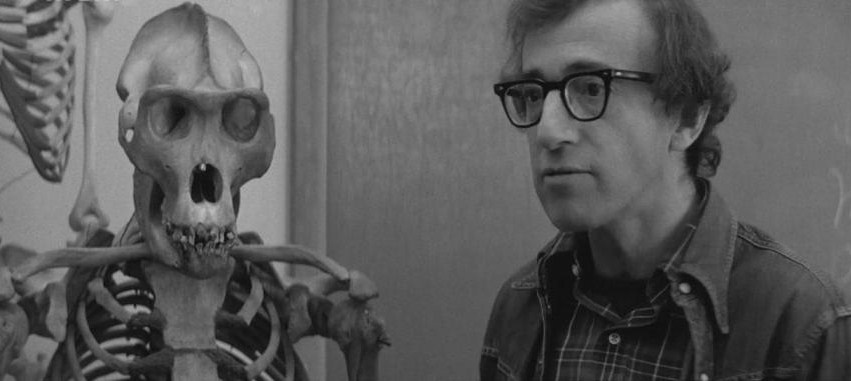
One can of course cite countless other similarly toned moments from Allen’s large body of work. (Remember the one set in a biology classroom in Manhattan, where Allen’s Isaac chastises a friend about an extra-marital affair, then points to a particularly ugly skeleton and says, “We’re going to end up just like him – and he was probably one of the beautiful people in his time”?) One could even go back to the 1960s when, as a stand-up comedian, he was trading in self-consciously morose humour on the same set of existential subjects.

And yet, for me, the two scenes mentioned above produce very dissimilar effects. Watching a 76-year-old pontificate about death (as in To Rome with Love) is a markedly different experience from watching the same man doing so in his 30s or 40s. It’s less easy to smile at.

Allen himself would not condone such a treacly attitude – the very idea would probably be distasteful to him – but for a long-time viewer these feelings are inevitable. One can spend half a lifetime admiring certain movie-stars for their (mental or physical) toughness and their lack of sentimentality (“lack of sentimentality” itself being a meaninglessly broad category that can include Woody Allen’s Borises, Alvys and Isaacs as well as Clint Eastwood’s Dirty Harrys and Blondies, to name just two venerably aged American actor-directors) – but as time passes they become vulnerable in one’s eyes. They may continue doing the same things onscreen but the way we receive and interpret those things changes. As Pauline Kael wrote in a related context about Katharine Hepburn and Bette Davis in 1968, “The two great heroines of American talkies have both gone soft on us, become everything we admired them for not being. They have become old dears – a little crotchety maybe, but that only makes them more harmlessly lovable.” Implicit here is the idea that the viewer’s perception is as important as what the actor is consciously doing.

When actresses begin to use our knowledge about them and of how young and beautiful they used to be – when they offer themselves up as ruins of their former selves – they may get praise and awards, but it’s not really for their acting, it’s for capitulating and giving the public what it wants: a chance to see how the mighty have fallen.
There have been a few exceptions: film artists whose work grew determinedly less sentimental with age – the most notable perhaps being that wily old surrealist Luis Bunuel, who made some of his sharpest films in his seventies when awareness of coming oblivion seemed almost to have fine-tuned his sense of the absurd. And indeed there are Bunuel-esque touches in To Rome with Love, such as a scene where an apparently shy, star-struck young woman accompanies a famous actor to his hotel room and ends up romping in bed instead with a thief who has broken in. But despite these moments – and despite the overall pleasantness of the film – I found it hard to shake from my mind the images of a frail-looking Allen, the skin on his face sagging, the eyes slightly more unfocused and the speech just a little slower than it used to be.

I felt a similar odd sensation a few weeks ago while watching the US Open men’s final, a five-hour marathon between Andy Murray and Novak Djokovic that must (partly because of the playing styles of the two men) have been nearly as fatiguing for the spectators as it was for the contestants. In the audience was Sean Connery – Sir Sean
Connery – lending his support to fellow Scotsman Murray; he looked as spry and bright-eyed as ever, but I may have spent as much time worrying about his health as I did thinking about the match itself. At some point, as the rallies wore on, he transformed in my mind’s eye from being one of the world’s most charismatic movie stars, the original 007 and a continuing object of adulation (the Twitter accounts of Murray and his team would soon be full of photos clicked with him) to being a crabby old man needing to take yet another toilet break and wishing these kids would get on with it. You can be the fittest 82-year-old in the world but you’re still, you know, 82 years old.

As for Amitabh Bachchan turning 70 next month – that’s such an incogitable prospect for my generation of Hindi-movie viewers, I won’t even address it in this space. It may require a book-sized lament.

P.S. To Rome with Love repeatedly contrasts “ordinary” people with people living in the public glare: two of its four plotlines (including the riotous one about a middle-aged undertaker who can sing like a world-class tenor only when he’s in the shower, necessitating bizarre productions of famous operas) deal head-on with the idea that people are alternately drawn to and repulsed by the celebrity life.

In a way this is a poignant reminder of how those who achieve stardom often cling to it at all costs, past their sell-by date. Some do it with a measure of dignity. The other day I was watching the iconic sequence in Limelight with Chaplin and Buster Keaton on screen together for the only time. Both men were around 60 then and had already been performers for five decades, having begun their vaudeville careers as children. You’d think after a lifetime of this sort of thing the old enthusiasm might have begun to wane, but not a bit of it. On the other hand, perhaps it was the only thing they knew how to do.

Selasa, 25 September 2012

The Big Indian Picture

A big shout-out for The Big Indian Picture, a new online magazine on cinema and culture (and congrats to a fabulous team that includes Pragya Tiwari, Kavi Bhansali and Rishi Majumder). The launch was held in Mumbai last evening and the site is now live - some content is up, with lots more to come, including essays, artwork, interviews and videos. So go ahead and bookmark, subscribe, follow etc. Here's the link again.