cooltext1867925879

~~ Mudahnya peluang usaha ~~

SUSU KAMBING ETAWA BUBUK 2015

E.A.P Teknologi BPTP YOGYAKARTA

header

1419847472700532415 ETAA  

Untuk itu awali tahun baru Anda dengan berwirausaha dan kembangkan bakat kewirausahaan Anda dengan bergabung bersama

header

~~SUSU KAMBING ETAWA BUBUK Ijin Edar LPPOM 12040002041209 E.A.P Teknologi BPTP YOGYAKARTA ~~

Halal MUI

Ibu Eri Sulistyowati Telp/sms 089651095115 Pin 28823f03

~~ PELUANG USAHA 2015 ~~ SUSU KAMBING ETAWA BUBUK ~~

  1. Bisnis paling menjanjikan dengan laba 100% milik sendiri tentunya akan sangat menarik untuk dijalani. ~~ SUSU KAMBING ETAWA BUBUK ~~
  2. sebuah usaha kemitraan yaitu ~~ SUSU KAMBING ETAWA BUBUK ~~
  3. membuka sebuah penawaran paling hot di Awal tahun 2015 yaitu paket kerjasama kemitraan dengan anggaran biaya @20.000 /kotak' (partai ecer) Untuk grosir bisa MendapatkanHarga hingga @15.000 WOOOW dengan mendapatkan benefir semua kelengkapan usaha.
  4. Anda bisa langsung usaha ~~ SUSU KAMBING ETAWA BUBUK ~~ dengan investasi yang ringan.
  5. Pada tahun 2015 banyak diprediksi bahwa usaha ~~ SUSU KAMBING ETAWA BUBUK ~~ masih sangat menjanjikan.
  6. Disamping pangsa pasar yang luas jenis usaha ~~ SUSU KAMBING ETAWA BUBUK ~~ juga banyak diminati. Konsumen yang tiada habisnya akan banyak menyedot perhatian bagi pemilik investasi.
  7. Untuk itu jangan buang kesempatan ini, mari segera bergabung bersama kami dan rasakan sendiri manfaat laba untuk Anda.

Tunggu apalagi, ambil telepon Anda dan hubungi kami melalui sms,bbm maupun email susukambingeta@gmail.com. Jika Anda masih ragu, konsultasikan dahulu dengan kami dan akan kami jelaskan mekanismenya. Proses yang sangat mudah dan tidak berbelit-belit akan memudahkan Anda dalam menjalani usaha ini. Kami tunggu Anda sekarang untuk bermitra bersama kami dan semoga kita biosa menjadi mitra bisnis yang saling menguntungkan. Koperasi Etawa Mulya didirikan pada 24 November 1999 Pada bulan Januari 2011 Koperasi Etawa Mulya berganti nama menjadi Etawa Agro Prima. Etawa Agro Prima terletak di Yogyakarta. Agro Prima merupakan pencetus usaha pengolahan susu yang pertama kali di Dusun Kemirikebo. Usaha dimulai dari perkumpulan ibu-ibu yang berjumlah 7 orang berawal dari binaan Balai Penelitian dan Teknologi Pangan (BPTP) Yogyakarta untuk mendirikan usaha pengolahan produk berbahan susu kambing. Sebelum didirikannya usaha pengolahan susu ini, mulanya kelompok ibu-ibu ini hanya memasok susu kambing keluar daerah. Tenaga kerja yang dimiliki kurang lebih berjumlah 35 orang yang sebagian besar adalah wanita. Etawa Agro Prima membantu perekonomian warga dengan mempekerjakan penduduk di Kemirikebo.

~~ Mudahnya peluang usaha ~~

SUSU KAMBING ETAWA BUBUK 2015

Ibu Eri Sulistyowati Telp/sms 089651095115 Pin 28823f03

~~ PELUANG USAHA 2015 ~~

~~SUSU KAMBING ETAWA BUBUK ~~

cooltext1867925879
apk free app download: Mahabharat
Tampilkan postingan dengan label Mahabharat. Tampilkan semua postingan

Kamis, 04 Desember 2014

Connecting dots (and being underwhelmed by Shyam Benegal’s Kalyug)

Usually, when adapting a book into a film, the scriptwriters don’t take it for granted that their viewers have read the source text; the movie should work on its own terms. But it gets trickier when a film tries to do new things with the template of a very well-known tale and a degree of familiarity is presumed. I enjoyed Vishal Bhardwaj’s Hamlet adaptation Haider when I saw it two months ago, but since then I have wondered how I would have felt if I had watched it knowing nothing about Shakespeare’s play. Because the thrill of connecting the dots was central to my viewing experience – noting how Bhardwaj and Basharat Peer had turned Rosencrantz and Guildenstern into buffoons who idolise Salman Khan, or anticipating the famous grave-digger scene, complete with the “Aha!” moment where Haider holds up a skull, and the goofy little song (“So Jao” – a take on the recurring links between sleep and death in Hamlet?) that would probably have delighted Shakespeare’s own, plebeian heart.

Would the descent into madness of Haider’s girlfriend Arshia have been credible if one weren’t prepared for it by knowledge of Ophelia’s tragedy? Possibly not: the film is cantering along at this stage, and the abrupt cut to the scene where Haider sees Arshia’s funeral procession might puzzle an unprepared viewer – I remember a few murmurings in the hall – especially since being reduced so quickly to a nervous wreck doesn’t seem consistent with Arshia’s personality (unlike the sheltered Ophelia, she is a journalist working in Kashmir, accustomed to seeing bad things happening).


To some extent the question “How important is pre-knowledge?” applies to all of Bhardwaj’s Shakespeare adaptations (even if the answer to the question is unclear or variable). The first and still arguably the best of them, Maqbool (Macbeth), began with a brilliantly atmospheric scene where two crooked cops gossip about the Bombay underworld and use astrology to predict a gangster’s rise and fall. The scene works well by itself, but gains a new dimension once you realise these are versions of Shakespeare’s witches, commenting from the sidelines while also helping to engineer and direct events. And who can forget Maqbool’s pitiful “Main bachunga ya maroonga?” followed by the witch/cop’s reassurance that he is safe until the “dariya” comes right up to his house, a Birnam Wood drifting to Dunsinane.

Anyway, what started me on this "adapting an over-familiar tale" subject was a recent re-encounter with Shyam Benegal’s 1981 film Kalyug, a modern-day Mahabharata about a business family split into rival factions. I loved Kalyug when I was 10 (back then it was the only Benegal film I would have touched with a long spoon, much less forced my mother to take me to Palika Bazaar to find a video-cassette of, as I did)... or at least I thought I loved it. Possibly what really stimulated me was the Mahabharata dot-connecting game (then as now, I was obsessed with the epic), and especially seeing my hero Karna sympathetically portrayed by the film’s biggest star (and producer) Shashi Kapoor.

Watching it again now, I was disappointed. It is enjoyable in bits and pieces certainly – the cast is full of interesting people, and the plot is busy enough: the cousins keep raising the stakes passive-aggressively until things get out of control; Amrish Puri plays a Krishna who doesn’t have anything like the agency and influence of the charioteer-God; Kulbhushan Kharbanda is an amusingly priapic Bheema; Rekha and Raj Babbar sleep in separate beds and look unhappy; the smooth Victor Banerjee looks as if he would be perfectly happy sleeping alone forever; Supriya Pathak is sexy. But these elements don’t add up to very much. The film shifts between big-canvas cynicism – with its caution about how, in the machine age, everyone sinks morally into quicksand – and trying to evoke sympathy specifically for one character, the underdog Karan (using Shashi Kapoor’s personality and star-cachet to achieve this without a great deal of help from the actual writing). There is a neither-here-nor-there feel to the whole, which is a reminder of the film’s unusual conception: getting a Serious Director to helm a project that would be backed by money and a cast of well-known names from the mainstream, but would also have the sort of verisimilitude that can be created by Om Puri seething and shaking his fists in a small part as a trade-union rabble-rouser.

Take away the Mahabharata-awareness and this is a confused story with too many characters, most of whom are underdeveloped and don’t get enough screen time. There are tensions and meaningful silences that don’t seem to stem from anything – except, well, as a viewer you are simply supposed to know that Karna was rejected by Draupadi at her swayamvara, or that Yudhisthira is a bit of a non-entity who is over-fond of gambling, or that Abhimanyu may simply have been an overenthusiastic kid who got too involved in adult games. And those who don’t know all this are naturally foxed. A non-Indian friend, who loves old Hindi movies but hasn’t read
Vyasa’s epic, had this take on Kalyug: she felt it played like a sort of home video where a viewer has all the relevant information beforehand about the people, and then indolently watches their little dramas play out. Interestingly, in the film itself, there’s a scene where the characters sit together watching a video of themselves at a wedding function. Vanraj Bhatia’s stirring music score aside, I’m not sure that Kalyug on the whole is much more interesting than that footage.

--------------------------------------------

Update: a follow-up conversation with my erudite friend/fellow Mahabharata nut Karthika Nair helped me articulate another reason why Kalyug didn't work for me this time: the best Benegal films, including the ones that are more "art-house", like Suraj ka Saatvan Ghoda or Mammo, are very far from the art-cinema cliche of the "boring", "educative" movie; they are kinetic and have a sense of style, they do interesting things visually (look at Nihalani's cinematography in Bhumika, and how it uses four  different types of film stock to capture different periods in the protagonist Usha's life). Whereas this film, for all its glamorous, "commercial" trappings, is formally static, and content to rest on the Mahabharata references.

[Two old posts about Benegal films I like very much: Trikaal and Charandas Chor. And this one on Junoon, written back when I was trying to sound more knowledgeable about Benegal than I actually was, and which I should probably watch again some time]

Jumat, 26 September 2014

Fornit, some Fornus - writers on writing

[From my Forbes Lifecolumn]

The American author Stephen King is too prolific to be easily categorised, but most people who know of his work from a distance think of him as a “horror writer” – he has, after all, published bestsellers about a psychotic dog, a homicidal clown, a creepy hotel with a mind of its own, and a girl who wreaks vengeance on her tormentors through her gift of telekinesis. But one of the scariest King stories I have encountered is the novella “The Ballad of the Flexible Bullet”, which is about a writer’s personal hell. The story is included in the collection Secret Windows: Essays and Fiction on the Craft of Writing, which, along with King’s On Writing, contains many valuable insights into his profession.

The framing device for the flexible-bullet story is a literary party where an aging editor recalls his association with a once-promising novelist named Reg Thorpe. Thorpe became convinced that his typewriter was inhabited by a “Fornit”, a tiny elf that sprinkled magic dust – Fornus – on the machine and was responsible for his creativity. Which sounds outlandish, but is it? As the editor’s account comes to its tragic conclusion and the party winds up, the wife of another young writer nervously asks “There are no Fornits in your typewriter, are there, Paul?” and we get this chilling sentence: And the writer, who had sometimes – often – wondered where the words DID come from, said bravely, “Absolutely not.”

Writers do wonder. Many of them don’t understand their processes – how the “muse” emerges, how quickly it can vanish, leaving no trace of the idea or the turn of phrase that had seemed so brilliant in the middle of the night – and some of them feel a painful disconnect between the thing they had in their minds and what finally emerged on the page. (Was the Fornit responsible for the bungled prose? Could the Fornit be a double agent?) Here is Ann Patchett in her memoir This is the Story of a Happy Marriage, on the conception and gestation of each new novel: “…the book makes a breeze around my head like an oversized butterfly whose wings were cut from the rose window in Notre Dame. This book I have not yet written one word of is a thing of indescribable beauty. […] When I can’t think of another stall, when putting it off has actually become more painful than doing it, I reach up and pluck the butterfly from the air. I take it from the region of my head and I press it down against my desk, and there, with my own hand, I kill it.” Patchett goes on to write movingly about the experience of seeing the dry husk of her beautiful friend on the writing table, “chipped, dismantled and poorly reassembled. Dead.”

All this can sound pretentious to those who think creative people romanticise their work needlessly rather than just “getting it done” – but nearly any serious writer has experienced these feelings, and their accounts often echo each other. Consider King’s little elf in the typewriter, and then look at Mishi Saran’s description of “the dwarf clamped to my shoulder – a mini-me – hissing into my ear”. This is from an essay in the fine new anthology Shaping the World: Women Writers on Themselves, edited by Manju Kapur. The book has many candid pieces by novelists such as Anita Nair, Moni Mohsin and Jaishree Misra, and while some of the points made are gender-neutral, they also touch on the specific difficulties of being a woman writer in a conservative society – many of the writers mention Virginia Woolf's famous essay “A Room of One’s Own”, about the financial independence and the emotional and physical space a woman needs in order to write.

Another of the most engrossing self-reflective books I have read in the past year is Vikam Chandra’s Mirrored Mind: My Life in Letters and Code, which tries to reconcile his two selves, the fiction writer and the software programmer. Chandra examines his trajectory as a reader and writer: for instance, he recounts how, as a youngster, he was divided between classical Indian forms of storytelling (with their episodic structures, logical discontinuities and narratives nestled within narratives) and the cool, minimalist “realism” of modern American writing (in creative-writing workshops in the US, the model to aspire to was the spare prose of Raymond Carver).

As Chandra knows, the writer as part of his own story – creating and participating at once – is a tradition that goes back a long way in Indian literature. Look at what happens early in the great epic the Mahabharata. A king has died heirless, his wives need children to carry the Kuru lineage forward, but no one with the right pedigree is able or willing to do this. At this point Vyasa himself, the poet and composer, enters the story and fathers the children who will in turn beget the epic’s protagonists the Kauravas and the Pandavas. Now the tale can continue. Did someone say deus ex machina?


Such a narrative arc is facilitated by stories that begin with oral recitations and gradually expand over time. (Picture a spoken story reaching a dead end, the audience impatiently asking “What happened next?” and the storyteller finding a way out by introducing himself as a character.) But some modern classics have also aimed for such an effect. Rabindranath Tagore’s Shey – translated from Bengali into English as He (Shey) by Aparna Chaudhuri – has for its protagonist a man who is made entirely of words. The book was written for Tagore’s granddaughter Pupe, and includes a number of unusual adventures and creatures; but as Chaudhuri points out in her introduction, storytelling is presented here as an interactive process – the tone changes with Tagore’s moods and Pupe’s demands, and also eventually reflects the difference in her personality as she grows from age nine (when the storytelling begins) to age 16 (when it ends).

Among more straightforward, linear fiction that has an author as a protagonist, a personal favourite is Somerset Maugham’s Cakes and Ale, in which a writer tries to uncover details about the life of another, deceased writer – in particular, to understand how the latter’s literary output changed with his personal circumstances, and what the contribution of his now-forgotten first wife Rosie was to his art. The result is one of Maugham’s most delicate books, an examination of the wheels behind the creative process and, importantly, a pretty good story in its own right.

Writers do sometimes stop navel-gazing for long enough to write about other, real-life writers. Martin Amis’s The War Against Cliché is a fine collection of essays on the methods of old masters (Milton, Donne, Cervantes) as well as contemporary practitioners of popular forms (Thomas Harris). More recently, there is Jonathan
Franzen's collection Farther Away, my favourite essay in which – “What makes you so sure you’re not the evil one yourself?” – is a celebration of the great short-story writer Alice Munro. Franzen notes how Munro is sometimes not taken seriously enough because she writes in conversational prose about everyday things, rather than about self-consciously Big Subjects; through a brilliant discussion of a particular short story, he analyses her talent for uncovering layer after painful layer in human character and relationships. So much of writing is implicitly a tribute to other writing (because everyone has been influenced by someone or the other), but this essay is that rare thing, one accomplished writer trying to make acquaintance with another well-known writer’s Fornit.

[More soon on Stephen King's excellent On Writing. And some earlier Forbes Life thematic columns here: popular science, satire, true crime, translations, doubles, time travel]

Minggu, 27 Juli 2014

More from the TV Mahabharat - a stylised blooding

Not that I’ve done any research on this, or intend to, but I wonder if episode 248 of the Star Plus Mahabharat – telecast on Friday night – represents a new frontier in the depiction of violence and gore in the history of Indian television. I suspect it does; I was startled by its vividness, even though one knows that the killing of Dushasana is not something that lends itself to refined, non-bloody treatment. In fact, even the YouTube version of the episode (which you can see here) is censored – some shots, including one where blood bursts like a geyser out of the dying man’s chest, have been excised. (This was also the case in earlier episodes involving the killing of Jarasandha and Shishupala.)

I have had a very complex relationship with this TV show over the months (and I intend to write about this at much greater length in the future sometime) – there have been some brilliantly conceived moments, some fine visuals, good performances and even intelligent writing, but there have also been far too many slack, simplification-riddled scenes, as well as internal inconsistencies and terrible pacing (nearly 10 episodes for the game of dice, followed by a hurried four or five episodes to depict the Pandavas's entire 12-year exile). However, I think there was much in this episode that was extremely well done, especially from around the 16-minute mark where Draupadi enters the battlefield and Bheema – who is practically in a trance at this stage, calling out to her in a hollow, robotic voice – begins the macabre ritual of washing her hair with Dushasana’s blood.

If you don’t like gore, you’re thinking: I don’t want to watch this, or even continue reading this. But (speaking as someone who does like gore, so possibly I’m not the best “objective” judge) I don’t think this scene is as viscerally revolting as it might have been. And the reason is this: it is heavily stylised. Everything about it is excessive and Grand Guignol – even the “blood” glistens and gleams, like the pig’s blood in the climactic scene of Brian DePalma’s Carrie – and while one could have seen that as a flaw in the production, in this case I think it perfectly fits the theatrical mood of the scene.


After all, this IS one of the most brilliantly hyper-dramatic passages in the Mahabharata. Apart from its importance as retribution, it is, from Bheema’s point of view, his moment in the sun – it represents a converging of almost every emotion he has experienced with regard to Draupadi, not just since that terrible day in the dice hall 13 years earlier, but also in larger terms: feeling unappreciated, second best, having to know that she feels much more deeply for Arjuna than for him. And here he is now, and here she is, and he alone is to be the agent of her long-desired vengeance, the one who will get to stroke and bind her hair after all these years of denial, while the other husbands and the other protagonists in this drama – even the puppet-master Krishna – are reduced to mute spectators, watching a performance. At the surface level, this is a depiction of a wronged woman being avenged (and the show has often drawn facile and somewhat problematic parallels between Draupadi’s story and the current public discourses about rape and capital punishment in India) – but at a deeper and darker level it is another vindication of the patriarchy, a depiction of a beast-like man asserting control and possession over a woman. And while this serial has hardly ever been radical about such things, I do feel that this subtext slips through in the scene. 


I never thought I’d say this about an Indian television actor (much less someone who was apparently cast in a role because of his physique and his experience as a wrestler), but I think the actor Saurav Gurjar, who plays Bheema, is pitch-perfect here. And the tone of the scene in general is very close to the many stylised depictions of this episode in our traditional dance forms like Kathakali. You can see one of those performances here, in an old episode of Shyam Benegal’s Bharat ek Khoj, starting around the 2.20 minute mark. It used to give me nightmares as a child.

[Earlier posts on the Star Plus Mahabharat: Bride of Frankenstein; Kryptonite Karna; the benevolent patriarchy]

Rabu, 26 Februari 2014

Pop goes the epic: Draupadi in High Heels, Karna’s Wife and other new-age retellings

[Yes, here I go obsessing about you-know-what again, this time for the Indian Quarterly, and with a focus on two new novels with Karna in a starring part. This is a slightly different version of the piece that appeared in the magazine]

-----------

In the glossy new TV version of the Mahabharata, there is a scene where the princess Gandhari blindfolds herself so she can join her soon-to-be-husband Dhritarashtra in the world of the unsighted. This is among the most dramatic early moments in Vyasa's epic, and is usually presented in exalted terms - the princess proclaiming her resolution; the flamboyant, and decisive, binding of the cloth around her eyes - which is why I was intrigued by the new show’s handling of the scene. Much of the shot is filmed as point of view: we see Gandhari holding the blindfold, but then we watch it through her eyes as it comes closer and closer to them, eventually blurring the whole screen. The effect is akin to a handheld-camera horror film, complete with scary music and agitated breathing on the soundtrack. An earlier episode has established that the princess is afraid of the dark and awakens in a cold sweat if the wind blows out the dozens of diyas in her room. What she is now doing to herself feels much more immediate.


One doesn’t have to read too much into this, of course. High production values and reasonably thoughtful script notwithstanding, this Mahabharata, telecast five days a week, is very much aimed at viewers of daily soaps – which means presenting incidents in mundane, homely terms, stretching scenes out endlessly, and setting up episode-closing cliffhangers. The blindfold scene is a set-up for the next, hyper-dramatic sequence where Gandhari enters the Kuru sabha for her wedding, and viewers – along with the other characters in the story – get to see her with her eyes covered for the first time.

But the scene works on another level too, by showing a majestic act in human terms. Rather than a self-assured princess reaching for the Grand Gesture with her thoughts on posterity, this is a scared, impetuous girl who may have made a decision without realising its implications (and of course, there will be major implications for the story). It makes Gandhari easier to relate to, sympathise with or chastise, and it also ties in with what a number of recently published books have been trying to do – to make these old stories more accessible, with results that are inventive and facile in equal measure.


Such retellings of epics are not in themselves a new phenomenon. There have been countless “perspective” versions across the Indian languages, some notable ones being from major writers such as MT Vasudevan Nair (Randaamoozham, translated from Malayalam into English by Prem Panicker for his blog, and then by Gita Krishnankutty for Harper Collins) and Shivaji Sawant (the Marathi classic Mrityunjay). But a majority of those works were in the realm of literary fiction, and aimed at readers who had a deep enough knowledge of the epic to want to explore alternate narrative possibilities. What has been happening recently is a little different: stories from the Mahabharata and Ramayana are being revisited in ways that would appeal to a wider range of readers, and in the garb of fast-paced genre fiction.

And inevitably, certain characters have special appeal for the new generation of bards. Prominent among them is Karna, half-brother of the Pandavas, who is abandoned as an infant, raised by low-caste foster parents and discovers his true identity too late. One of ancient literature’s most compelling tragic heroes, Karna is a notably "modern" figure even in straightforward Mahabharata translations. His presence continually runs against the very assumptions of the period – such as the “God-granted” division of people into social hierarchies by their birth rather than their capabilities – and raises uncomfortable questions for the other characters as well as for the reader. (What happens when a person comes up against consistently hostile circumstances, or when personal dharma collides with what is perceived as the greater good?) The new TV show gives Karna rousing speeches where, apparently addressing the camera directly, he punctures the hubris of the high-born people around him, including one where he sharply tells the Brahmin teacher Drona that there is no such thing as a divine or magical birth, because every birth is a wondrous event for the parents concerned.

An earlier issue of this magazine carried an essay about literary crushes. As a child, traversing the vast landscape of the Mahabharata, I was obsessed with Karna, and could see him as the template for the angry young men played by Amitabh Bachchan in films like Trishul. Reading C Rajagopalachari’s translation of the Mahabharata aloud to my mother, I would sometimes excise sentences that showed Karna in a poor light. In my defence, I was all of ten years old; but it means I can relate to the many attempts now being made to turn Karna into an almost conventional, vanilla hero rather than a deeply complex person capable of extremes of anger and spite.

My literary crush was a platonic one, but two new books, both written by women who clearly feel strongly about Karna, explore his possibilities as a romantic hero. In these novels, Karna – about whose love life we learn almost nothing in the original Mahabharata – has transformed into an irresistible, golden-eyed (or blue-eyed) hunk, a sensitive new-age metrosexual, a darkly mysterious stranger who is essentially good-hearted and who might be saved by the love of the right woman. Both books begin with the heroine’s first glimpse of this man, whose physical features and personality are described in near-fetishistic terms. A strong strain of wish-fulfillment runs through them, and both are roughly classifiable (if you like classifying books) as “commercial” or “mass-market” fiction, though in my view they are very different in quality.


The less interesting of the two, Aditi Kotwal’s Draupadi in High Heels – an entry in Penguin India’s Metro Reads imprint for popular fiction – centres on a poor little rich girl named Deeya Panchal who, in the midst of jet-setting around the world, socialising with the likes of Sonam Kapoor at fashion shows and brooding about ex-boyfriends, discovers that her life has uncanny parallels with the mythological Draupadi's. For one thing, she is in degrees of romantic or potentially romantic entanglements with three suave, business-family brothers, the modern-day versions of the Pandavas (“Uggh. I suddenly felt like a doll which was being passed around from one brother to the other”). She also confides important matters to a close friend named Krish Gopinathan (Krishna), and is drawn to a handsome social outsider named Karan, whose origins are “shrouded in mystery”.

Though the framework here is the genre often derisively called chick-lit (“brat-lit” might be more accurate for this novel), the central idea has been explored before. The possibility of an unarticulated connection between Karna and Draupadi – both fiery, headstrong people – has persisted for a while in folklore and in regional extrapolations of the epic; it was there in Pratibha Ray’s celebrated Oriya novel Yagnaseni, in P K Balakrishnan’s Malayalam Ini Njan Urangatte (translated into English as “Now Let me Sleep”) and more recently in Chitra Banerjee Divakaruni’s The Palace of Illusions, which ended in a bohemian post-war Heaven where Draupadi is finally free to express her real feelings for Karna.

In contrast, the Deeya of Draupadi in High Heels goes about her work on terra firma. She not only chooses Karan to be her life partner, but also helps him discover his real identity. (He was the product of a hushed pre-marital affair involving a socialite and her German boyfriend in England!) The book’s final two sentences – “As I looked into his light-brown eyes which glowed with abundant love, I realized that a man with a golden heart like his deserved all the happiness and acceptance in this world. And I was so glad that I got to share these moments with him!” – should tell you everything you need to know about the mawkishness of the prose, as should the supposedly descriptive passages (“What fascinated and captivated me the most was his face – which was the most perfect that I had ever seen!” and “Some strong, indefinable feeling swept through my body and found its place at the bottom of my stomach”). 


But they will also tell you that this is an attempt to give Karna a happy ending, to retrospectively correct the wrongs done to this anti-hero – and in fact, this impulse is common to many Mahabharata-retellers. In 1991, the acclaimed film director Mani Rathnam made Thalapathi, with Rajnikanth as a modern-day Karna, which ends with the protagonist achieving validation and self-worth. “[As a reader] I’ve always wished that he lived on,” Rathnam told Baradwaj Rangan in one of the interviews in the book Conversations with Mani Ratnam, “So much has gone wrong. There’s so much stacked against him. Maybe there’s a bit of hope, a bit of optimism in this, but I felt that his death would look too doomed, too tragic.”

The other new Karna-as-romantic-hero book is Kavita Kane’s Karna’s Wife, redundantly sub-titled “The Outcast’s Queen”. Despite its weak points – flat dialogue, for one – this is unquestionably a more serious-intentioned work than Kotwal’s, and founded on a closer psychological understanding of the epic. (Kane has probably read her Mrityunjay too.) The protagonist here is a freshly created character, a princess named Uruvi who becomes Karna’s second wife after performing an action that is exactly the opposite of Draupadi’s: she rejects Arjuna, whom everyone expected her to marry, in favour of the intense social outcast.

A problem with some “perspective” versions of the Mahabharata is that they turn their protagonists into near-omniscient narrators – The Great Golden Sacrifice of the Mahabharata, for instance, is part-narrated by an Ashwatthama who seems blessed with a panoramic view of everything that is happening to all the other characters. The same charge could be leveled at Karna’s Queen: the fictional Uruvi conveniently happens to have grown up around the elders of Hastinapura and is even the foster-daughter of Kunti (mother of Karna and the Pandavas), which means she is privy to all sorts of information. The very opening page is a description of her first view of Karna when he challenges the Kuru princes during their competition; Uruvi has a ringside seat here, right next to Kunti, and she chirps on in modern slang, providing such commentary as “Bhima is downright mean!” and “Ma, please, it’s fair enough!”

At this stage I was ready to dismiss Karna’s Wife as another facile retelling, but reading on I found points of interest in it. Uruvi – even though she is part of Karna’s life and is affected by his actions– can be viewed as a sutradhaar figure who is essentially outside the narrative, a stand-in for the author. It is almost as if Kane traveled in a time machine to Hastinapura (think of Mark Twain’s A Connecticut Yankee in King Arthur’s Court) and then set about confronting major characters like Bheeshma, Kunti, Duryodhana, and Karna himself, and either telling
them off or getting a clearer understanding of their feelings. If one were to be really generous to this book, one might say that what she has attempted (consciously or otherwise) is a form of literary and social criticism – revisiting the story as a 21st century person, bringing modern morality to it, and doing this not from a safe distance but as an insider. (In an interview, Kane was asked which character from the Mahabharata she would like to meet and speak with. “Karna, of course!” she replied, “And I would have done exactly what Uruvi did.”)

If Karna is a dashing lover in these books, the new TV show also presents him in terms that resemble the Western comic-book superhero. Poetic licence has been taken with the impenetrable armour and earrings attached to his body, gifts from his divine father, the Sun God. In a touch that may remind you of Clark Kent turning into Superman in the phone booth, the new serial has the protective armour making its appearance only in specific moments of crisis; it then spreads across Karna’s muscular abdomen, which, seen in close up, resembles that of modern superheroes in full gear. The parallel with Superman, who is encased as a baby in a protective bubble by his father Jor-El, is hard to resist. And of course, the armour will also turn out to be Karna’s Kryptonite when he has to give it away. All of which may be a way of reminding oneself that the Superman story is itself a modern myth that is derivative of ancient ones. The circle completes itself here.

****

It’s worth asking why the epics are such an endlessly replenishing mine for contemporary writers. One obvious answer is that these are rich stories with multiple strands, forever open to new interpretations and psychological analyses. A more cynical answer would be that they provide lazy or unimaginative authors with a ready-made template: the plot, structure and character types are largely in place, and the embellishments (or twists, as in Draupadi choosing Karna over Arjuna) are all that are needed.

Everything hinges then on the quality of execution, on what new ideas are introduced, and how convincingly they are injected into an existing palimpsest. One of the more notable (in theory at least) attempts to shift the epic to a modern setting was in Sandipan Deb’s gangster novel The Last War, which set the Mahabharat in the Mumbai underworld, casting Arjuna and Karna as Jeet and Karl, two expert hitmen primed for a final showdown. It was a good idea to move the story to the Bombay of the last 60 years, letting the many familiar dramatic episodes play out against the backdrop of a fast-changing city, with occasional references to such real-life events as cricket match-fixing. (In this version, Yudhisthira goes to jail when he is tricked and implicated in a cricket-betting controversy.) And there is an irreverence built into the book's very fabric: the very first chapter has the modern versions of Krishna and Arjuna faux-philosophising over glasses of Scotch, and all the characters are basically thugs.

But this also raises questions about Deb’s decision to lift plot details and even dialogues wholesale, and to clumsily stick them into situations where they become anachronistic. For instance, the episode of Arjuna seeing only the eye of the wooden bird he has to shoot at is presented exactly as it is in the original, except that of course he is using a rifle. After Draupadi (called Jahn here) is nearly raped, she swears that she won't tie or oil her hair until she has soaked it in her assailant’s blood. Besides, the prose includes several pretentious references to “dharma” or duty. Deeply ambiguous as this concept already is in the original Mahabharata, it is rendered meaningless in a situation where everyone is operating outside the law.

However, one might note that even in this amoral version – where there are no real standards of “good” and “evil” – the Karna character is the one who secretly makes the phone call that helps preserve Draupadi’s honour. It seems that even the author of a hard-boiled underworld rendition of the epic can’t resist whitewashing Karna, almost to the point where his complexities are siphoned away.

That’s another feature common to contemporary retellings though: the need to subvert conventional ideas about the “bad guys”, or to reveal the shaky moral foundations of the “good guys”. Among recent books, there are Anand Neelakantan’s Asura and Ajaya, which eschew the history-as-told-by-the-victors narrative to present the Ramayana and Mahabharata through the eyes of Ravana and the Kauravas respectively. The Rama-Sita relationship has been thoughtfully dealt with in such modern-lens retellings as Samhita Arni’s The Missing Queen (a “speculative thriller” about a journalist’s search for Rama’s missing wife after the war with Lanka) and Sita Sings the Blues, an animated film by the American Nina Paley, who intersperses episodes from the Ramayana with the story of Paley’s own estrangement from her husband.


And always, there is the story of Surpanakha, Ravana’s sister who becomes the catalyst for events in the Ramayana after she is rebuffed and disfigured by Rama and Lakshmana. The incident – though presented in terms of the good guys giving a demoness her just desserts – is an inherently ambiguous one, and can be interpreted in terms of gender-directed or caste-directed violence. This has been done many times in modern fiction (an example being Amit Chaudhuri’s spare, uncompromising short story “An Infatuation”), but one of the most enjoyable Surpanakha retellings I have read is a piece in the anthology Breaking the Bow, which collects speculative fiction inspired by the Ramayana. Kuzhali Manickavel’s “The Ramayana as an American Reality Television Show” is a clever account of how the Surpanakha episode may have unfolded in the voyeuristic-exhibitionistic cyber-age, with statements from the aggrieved rakshasi’s blog, the hysterical social-media reactions by her fans and detractors, and Twitter ripostes by the “Real Rama”. It adds up to a commentary not just on the ancient epic (it is easy for contemporary writers to poke holes into the social mores and pomposities of an earlier era) but also on the vagaries of our own time.

In any case, the past few months alone have brought us romantic Karnas, a gangster Mahabharata and the Ramayana as science fiction and thriller, along with prolonged daytime soaps where one might conceivably, in future episodes, get to see Duryodhana helping his son with his Algebra homework. And all this in addition to the ever-growing corpus of books by Amish Tripathi, Krishna Udayashankar, Ashok Banker and others, where Indian mythology is retold in a style resembling 20th century Western fantasy from Tolkien onwards. Or Amruta Patil's beautifully illustrated visual retelling, Adi Parva. But why stop there? Other genres and tropes are yet to be explored. Personally I am toying with the idea of getting onto the bandwagon and fashioning two of my personal obsessions – tennis and irreverent humour –
into Mahabharata novellas. One of them would stage the Kurukshetra war as a series of Grand Slam matches, with the Karna-Arjuna battle played out in the manner of a Roger Federer-Rafael Nadal epic in a Wimbledon final. (As Orwell said, sport is war minus the shooting. Such a story would require no “arrows can be injurious to health” signs.) The other would cast Groucho Marx as a non-sequitur-spewing Krishna, confounding Arjuna and everyone else on the battlefield with a modern Gita that begins “These are my principles. If you don’t like them, I have others.” Like Groucho, the epic is whatever you want it to be.

-------------------

[Some related posts: the Rashomon-like world of the Mahabharata; Iravati Karve's Yuganta; The Palace of Illusions; The Last War. The PDF of Prem Panicker's Bhimsen is here. And something about the Karna-as-Rafa illustration that went with the piece.]

Selasa, 11 Februari 2014

Quick thoughts on the pulping of The Hindus (and the benevolent bully)

Some thoughts in connection with the depressing - but not, in our times, very surprising - news about the “pulping” of Wendy Doniger’s book The Hindus by Penguin India (after a petition that, among other things, alleges that Doniger’s “approach is that of a woman hungry of sex”, that a Shiva linga can only be a cigar, so to speak, and that the idea of Krishna having an erotic life is unthinkable and un-Hindu).

I have written before about the smug certitudes that so often accompany religious belief, and the sophistry/cherry-picking inherent in the thought process that goes: “THIS is what the scriptures really meant, and it’s all good and clean and pure and exactly as I want it to be. Anything else – anything that makes me uncomfortable, or doesn’t fit the accepted moralities of today, or makes the Gods seem imperfect, or even vaguely suggests that those old books may have been a product of their age rather than containing unassailable wisdom and truth for all time – any such thing HAS to be a flawed reading, or a later corruption of the text. Or, wait, it can be interpreted THIS way, which makes everything okay again.”

This thought process isn’t limited to those whom we can conveniently label “fanatics”. Some generally intelligent people I know, including some who aren't especially religious, often bring up that beautiful, soothing – and nonsensical – idea that all religions “in essence” or “in their original form” teach love, universal brotherhood, tolerance and non-violence. A cursory reading of the major works of ancient literature shows how bizarre this claim is. But of course, once you know, with absolute certainty, that they really are all divine texts, that so-and-so really WAS a God, and that Gods by definition are good and all-knowing and so on, it becomes easy to rationalise anything.

I had an email conversation with a friend today – it touched briefly on the Doniger episode, but it began as a discussion of the new TV Mahabharat, which (no surprise) depicts Krishna as a forever-in-control avatar, constantly manipulating events towards the Greater Good, interfering in every scene to such a degree that you feel all the other characters could easily have been played by mannequins with little strings attached to them. Compared to this beacon in man-shape, even the Krishna of the B R Chopra serial – a fairly populist show in its time – was a flawed, sometimes conflicted, likably human character.

Anyway, I was telling my friend about the new show’s whitewashing of nearly every dubious action performed by the “good guys”, the Pandavas and Draupadi, how it glibly stacks the cards in their favour, and against those who are on the side of “adharma”. There is a scene at Draupadi’s swayamvara where Krishna meets Karna for the first time and tells him something like, “If you don't get respect – sammaan – it means you have not followed the path of dharma.” Karna asks “But what about someone who has never known respect, right from his earliest days?” and to this Krishna smiles sweetly and wags his finger and says “Oh, in that case, you must strive all your life for respect. But don't do it by siding with adharma.”

One gets the gist of what is being said, and even buys into it to a degree if one is hung up on the Bhakti Tradition Krishna and the Mahabharata-as-Morality-Tale. And I’m not suggesting that the injustices done to Karna be used to justify or even gloss over the wrongs he participates in. But this scene (and there are others like it) presents such a simple-minded view of what is good and what is bad, and such an undermining of lived experience. As I told my friend on email, if this Krishna travelled to modern-day Delhi and met an autorickshaw driver who had just been smacked hard by a rich kid in a BMW because their vehicles had grazed each other, he'd probably say the same thing with the same expression.

She replied: “That is what I find so fearfully disturbing about the […] discourses of today: they all conspire (consciously or otherwise) to vindicate a certain hierarchy by transforming it into benevolent, enlightened patriarchy, striving to achieve everyone's well-being. Poppycock.” Well said. There are so many versions of this benevolent patriarchy. (“Yes, yes, we believe in freedom of speech too,” they say with indulgent smiles, “But, you know, this will hurt so many feelings. Couldn't you avoid writing it?”) And we see a form of it in the objections to books like Doniger’s, by people who want a single, standardised, comforting version of things, with nothing that will rock any boats.

[Related thoughts in these posts: Arun Shourie on innocents in a Godless world; divine savages and “real” truth; tales from a crematorium; Chetan Bhagat and “liberal extremism”]

Sabtu, 01 Februari 2014

Rafa the low-born (tennis at Kurukshetra)

Had to share this. I wrote a piece for the magazine Indian Quarterly recently, about a new crop of epic retellings being done in popular genres such as young romance and the underworld thriller. The piece – which centred on two new books about Karna, one of my childhood literary heroes – ended with a jokey line about how, if I ever did a Mahabharata-retelling myself, I would merge my personal obsessions and present the Kurukshetra war as a series of Grand Slam tennis matches: 128 warriors, falling by the wayside one by one (over 18 days, or over a fortnight), all of it leading up to a grand finale - the decisive Arjuna-Karna battle, cast as a meeting between Roger Federer and my favourite sportsperson Rafael Nadal.

It was a throwaway reference, not central to the piece in any way, so imagine my surprise when I saw a PDF of the story and found that the illustration done for it brought together Karna and Rafa (dressed in Wimbledon whites, including the sleeveless kavacha he wore until a few years ago) in one surreal, bow-and-bandana juxtaposition. I didn't have anything to do with planning the image, so this was most fortuitous, and I must thank the illustrator Salil Sojwal. Here’s the picture:


Illustration: SALIL SOJWAL

Of course, one is now tempted to make Nadal: Federer = Karna: Arjuna analogies, based on nothing more concrete than the facile perceptions we form of sportspeople. Thus, Roger as the privileged prince and favoured son, all grace and artistry, seemingly born to conquer the world, his destiny pre-written in stone; and Rafa as the dark cloud on his horizon, the upstart shaking up the fraternity with his unconventional style of play and his apparently uncouth mien (which conceals a sweet but defensive nature). Roger pirouetting his way across tennis courts with a sense of entitlement, while Rafa plays catch-up, struggling with the slings and arrows of outrageous fortune: chronic injuries, a style of play that doesn’t meet the aesthetic demands of people who want their tennis to be like ballet, and an inability to make himself properly understood – which in one famous case after the 2006 French Open led to public booing because he had been mistranslated. (“Chale jao, suta-putra,” yells the Hastinapura crowd.)

I could go on, but I won’t. Instead here are two photos of cho-chweet bonding between rivals. The first is from the great years of the Roger-Rafa bromance (more on that in this post); the second is from a recent episode of the Star Plus Mahabharat where Karna helps Arjuna (disguised here as a brahmin) lift a chariot wheel out of the mud (!!). Can't see the resemblance? Either there is no poetry in your soul, or you have better things to do with your time.


"
"VAMOS!!!"

Selasa, 21 Januari 2014

Bride of Frankenstein

Having lately discovered that Karna and Superman are the same person, I have now unearthed similarities between Draupadi and the Frankenstein monster. This is best illustrated with screen grabs from the Star Plus Mahabharat and old movie versions of the Mary Shelley story.

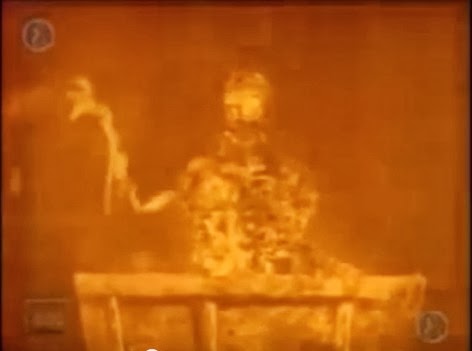
First, behold how the monster (in the 1910 film, that is) and Draupadi are each born of fire – though one emerges from a vat, the other from a sacrificial yagna:


(More about the fire scene in that old Frankenstein film here)

Next, mark ye, that both these hapless creatures (still coming to grips with the strangeness of the world around them) are surprised by their reflections in a mirror:


As they settle in, they each befriend a little girl and sit with her by the side of a pond, playing with flowers and such.


Much of the emotional impact of those scenes comes from the knowledge that the fire-princess and the monster have never experienced the joys and wonders of childhood. But grown-ups can have fun too. Here is Paanchali doing something that would get Boris Karloff lurching manfully towards her swayamvara:


[Coming up next: Bheema and Jughead Jones]

Sabtu, 18 Januari 2014

Emotional palettes: Vikram Chandra on mixed rasa in ancient literature and popular cinema

There are so many stimulating things in Vikram Chandra’s new book Mirrored Mind: My Life in Letters and Code that I won’t try listing them all – or doing a consolidated review – but one passage that struck a chord was a reference from the Mahabharata’s Stree Parva, the book about the women on the post-war battlefield. In the original text, Gandhari’s extraordinary monologue includes a description of the slain warrior Bhurishravas’s wives finding his severed arm, then holding and caressing it. The imagery haunted me for a long time when I first read it (in the Kamala Subramanian version, I think; the more literal and dreary Kisara Mohan Ganguli translation is on this page) and I was reminded of it when I read Mirrored Mind. Chandra quotes a rendition by the ninth century scholar Anandavardhana wherein one of the wives, gently stroking the gory limb she has placed on her lap, says:
“This is the hand that took off my girdle,
That fondled my full breasts,
That caressed my navel, my thighs, my loins,
And loosened my skirt.”**
Here is, as Chandra points out, an example (one of countless in the Mahabharata) of the mixing of rasas. “The stable emotion of grief is made sharper and more profound by the tasted memory of the erotic. And this provides, for the reader, the savouring of karuna-rasa, pathos.” In other words, the tone of an essentially tragic scene has been heightened by the introduction of a very different – some might even say inappropriate – mood.

Concepts like rasa (the aesthetic pleasure derived from tasting artificially induced emotions while watching a performance), dhvani (the resonance that poetry can create within a reader) and vyanjan (suggestion) have informed artistic expression in India for centuries, and Chandra writes about them at some length, drawing on the work of Anandavardhana and Abhinavagupta, and discussing the function of rasa and dhvani in old literature. But he also mentions a more modern medium.

The urge to savour is universal, but its expression is culturally shaped. Indian movies mix emotions and formal devices in a manner quite foreign to Western filmgoers; Indian tragedies accommodate comedic scenes, and soldiers in gritty war movies can break into song.

According to Anandavardhana: “While it is well known that larger works contain a variety of rasas, a poet who seeks the excellence [of his works] will make just one of them predominant… [But there is] no obstruction to a single rasa by its being mixed with others…Readers with a ready sense of discrimination, who are attentive and intelligent, will rather take a higher degree of pleasure in such a work.”
Chandra continues:
A song in an Indian film is an interlude which exists outside of story-logic and story-time, but within the emotional palette of the film; its function is to provide subsidiary rasas that will strengthen the predominant rasa of the whole.
****

I had a nice session with Chandra the other day (two sessions actually, a private conversation followed by a public one), and part of our discussion was about the often-uninformed, kneejerk denigrating of works that are deemed “unrealistic” or “melodramatic”. When I interviewed him in 2006, he had said:
I feel very strongly about this notion of what is "too filmi" as opposed to what is realistic. In India, especially in the upper and middle class, we've had an education that's trained us to see reality in a specific way, which mostly comes from the tradition of psychological realism. So when we see the other kind of representation – of mainline cinema – we deny its reality. But the idea that the novelistic/psychological-realism form can transparently give us what is "real" is very naïve. It's a distressing aspect of critical talk, and given the history of colonialism, we should be more suspicious of this idea.
(Full interview here)

Related points are addressed in Mirrored Mind. In a chapter titled “Histories and Mythologies”, Chandra recounts how, as a young writer, he was divided between classical Indian forms of storytelling (with their episodic structures, logical discontinuities and narratives nestled within narratives) and the cool, minimalist “realism” of modern American writing (in creative-writing workshops in the US, the model to aspire to was the spare prose of Raymond Carver). And he writes very eloquently about “the cult of modernity”: how imperialism required that colonisers cast the colonised as primitive, childish, undeveloped, and sentiment-driven; how entire modes of artistic expression get labelled inferior and “premodern” as a result; and what effect that has had on how we continue to view our art and culture even in post-colonial times. Alluding to Joseph Conrad’s description of Africans making “a violent babble of uncouth sounds” in Heart of Darkness, he says:
The irony here is that apart from the African languages that Conrad reduces to “babble”, the frightening “throb of drums” that he refers to several times contains a sophisticated artificial language rich in metaphor and poetry. The drummers carried on conversations with each other, made announcements, broadcast messages. James Gleick tells us that this language of the drums metamorphosed tonal African languages into ‘tone and only tone. It was a language of a single pair of phonemes, a language composed entirely of pitch contours’ […]
These parts of Mirrored Mind particularly appealed to me because I can relate – to a degree – with Chandra’s ambivalence. My own informal “education” in cinema – taking the medium seriously, as something that could be analysed and written about – really began when I exited the world of Hindi films in my early teens, became obsessed with old American films, and began reading criticism by V F Perkins, Robin Wood and others; criticism that was very much rooted in the models of psychological realism, and in a limited worldview where an Indian director worthy of being held up as a major creative force would have to have the particular sensibility and method of a Satyajit Ray. 

It is only in the past few years that I have rediscovered the creative energies of the really good popular Hindi films, and attempted – as a viewer and writer – to understand their “language” and the assumptions underlying it. And so, even while I have written posts like this one in response to sweepingly condescending pieces about Indian cinema – or this one about Hindi-movie songs – there’s a tiny part of me that still feels a bit embarrassed about the tropes of our popular movies; still reluctant to fully embrace the best of them as art (as opposed to “enjoyable entertainment, but nothing more”). There is some irony here, because when it comes to old Hollywood, I have always found it easy to reject Pauline Kael’s simplistic Art vs Trash formulation. I have no trouble placing popular or genre films like Hawks’ Monkey Business in the same circle of artistic merit as more obviously serious-intentioned films. But it feels like a greater leap to put a popular Hindi movie – even one that is extremely well made and has a fully realised “emotional palette” – in that circle. It’s an aspect of my conditioning that I struggle with.

****

Like I said, there is much else of interest in Mirrored Mind, though it is a difficult book in places: an honest report of the reading experience might be “Stirred, then daunted, even stupefied, then stirred again”. It isn’t easy to get into it – if you know nothing about the world of code and computer programming, you might back gingerly away on seeing the first page with its List of Figures that goes “CIL for Hello, world! program in C#” and “Subtraction operator with inputs 4.2 and 2.2” and suchlike.

When I last encountered Chandra’s work, it was in the form of Sacred Games, that epic novel about cops and gangsters in Mumbai – a fast-paced, accessible thriller as well as a thoughtful look at human lives and destinies colliding in a dynamic city, with the reverberations of the distant past constantly running through those lives. So coming to Mirrored Mind, all this talk about algorithms and logic gates and computer programming was a bit scary. But a couple of things happened as I continued reading. First, Chandra’s writing made the world of code and software immediate and interesting. Second, the book morphed gradually into other things. It became a memoir of a reading life and a writing life – of Chandra’s coming of age as a writer, his parallel life in programming, and how the two pursuits have intersected, diverged, or complemented each other (“the stark determinisms of code were a welcome relief from the ambiguities of literary narrative”). And eventually, a wide-ranging history of Sanskrit grammar and theory.


That might seem a quirky range of topics for a single book, but they come together very well here, and there are all sorts of little ideas and revelations. For instance, it was news to me that good code can aspire not just to functionality but to elegance and beauty as well; that an ambitious programmer can be like a writer who wants to polish his sentences and express himself as well as possible, rather than simply relay information. At one point Chandra quotes Donald Knuth, author of The Art of Computer Programming, who was underwhelmed by a particular code: “It was plodding and excruciating to read, because it just didn’t possess any wit whatsoever. It got the job done, but its use of the computer was very disappointing.” 

Which almost suggests that a version of the form-and-content debate may exist even in this seemingly cold, mechanical world! Perhaps future editions of the Jaipur Literature Festival can have sessions with titles like “Visual Basic, C# and FORTRAN: three celebrated programming languages discuss what aesthetic transcendence means to them."

-------------------

** The Stree Parva excerpt above is from Luther Obrock’s English translation of Anandavardhana’s Dhvanyaloka