cooltext1867925879

~~ Mudahnya peluang usaha ~~

SUSU KAMBING ETAWA BUBUK 2015

E.A.P Teknologi BPTP YOGYAKARTA

header

1419847472700532415 ETAA  

Untuk itu awali tahun baru Anda dengan berwirausaha dan kembangkan bakat kewirausahaan Anda dengan bergabung bersama

header

~~SUSU KAMBING ETAWA BUBUK Ijin Edar LPPOM 12040002041209 E.A.P Teknologi BPTP YOGYAKARTA ~~

Halal MUI

Ibu Eri Sulistyowati Telp/sms 089651095115 Pin 28823f03

~~ PELUANG USAHA 2015 ~~ SUSU KAMBING ETAWA BUBUK ~~

  1. Bisnis paling menjanjikan dengan laba 100% milik sendiri tentunya akan sangat menarik untuk dijalani. ~~ SUSU KAMBING ETAWA BUBUK ~~
  2. sebuah usaha kemitraan yaitu ~~ SUSU KAMBING ETAWA BUBUK ~~
  3. membuka sebuah penawaran paling hot di Awal tahun 2015 yaitu paket kerjasama kemitraan dengan anggaran biaya @20.000 /kotak' (partai ecer) Untuk grosir bisa MendapatkanHarga hingga @15.000 WOOOW dengan mendapatkan benefir semua kelengkapan usaha.
  4. Anda bisa langsung usaha ~~ SUSU KAMBING ETAWA BUBUK ~~ dengan investasi yang ringan.
  5. Pada tahun 2015 banyak diprediksi bahwa usaha ~~ SUSU KAMBING ETAWA BUBUK ~~ masih sangat menjanjikan.
  6. Disamping pangsa pasar yang luas jenis usaha ~~ SUSU KAMBING ETAWA BUBUK ~~ juga banyak diminati. Konsumen yang tiada habisnya akan banyak menyedot perhatian bagi pemilik investasi.
  7. Untuk itu jangan buang kesempatan ini, mari segera bergabung bersama kami dan rasakan sendiri manfaat laba untuk Anda.

Tunggu apalagi, ambil telepon Anda dan hubungi kami melalui sms,bbm maupun email susukambingeta@gmail.com. Jika Anda masih ragu, konsultasikan dahulu dengan kami dan akan kami jelaskan mekanismenya. Proses yang sangat mudah dan tidak berbelit-belit akan memudahkan Anda dalam menjalani usaha ini. Kami tunggu Anda sekarang untuk bermitra bersama kami dan semoga kita biosa menjadi mitra bisnis yang saling menguntungkan. Koperasi Etawa Mulya didirikan pada 24 November 1999 Pada bulan Januari 2011 Koperasi Etawa Mulya berganti nama menjadi Etawa Agro Prima. Etawa Agro Prima terletak di Yogyakarta. Agro Prima merupakan pencetus usaha pengolahan susu yang pertama kali di Dusun Kemirikebo. Usaha dimulai dari perkumpulan ibu-ibu yang berjumlah 7 orang berawal dari binaan Balai Penelitian dan Teknologi Pangan (BPTP) Yogyakarta untuk mendirikan usaha pengolahan produk berbahan susu kambing. Sebelum didirikannya usaha pengolahan susu ini, mulanya kelompok ibu-ibu ini hanya memasok susu kambing keluar daerah. Tenaga kerja yang dimiliki kurang lebih berjumlah 35 orang yang sebagian besar adalah wanita. Etawa Agro Prima membantu perekonomian warga dengan mempekerjakan penduduk di Kemirikebo.

~~ Mudahnya peluang usaha ~~

SUSU KAMBING ETAWA BUBUK 2015

Ibu Eri Sulistyowati Telp/sms 089651095115 Pin 28823f03

~~ PELUANG USAHA 2015 ~~

~~SUSU KAMBING ETAWA BUBUK ~~

cooltext1867925879
apk free app download: Rafael Nadal
Tampilkan postingan dengan label Rafael Nadal. Tampilkan semua postingan

Senin, 31 Maret 2014

Meeting two frosty women and a tennis stadium in Paris

Some people go to Paris to see the Louvre, the Orsay, the Latin Quarter or the Eiffel Tower. I scoff at these plebs. My personal Mecca and Medina and Vaishno Devi and what have you converged at two of the city's less touristy venues. First, the Cinémathèque Française museum, and a darshan of two women who have haunted my dreams since my early teens.


Forget the Mona Lisa – the real enigmatic Parisian lady is the robot from Metropolis. Behold these photos wherein two men, 90 years apart, try to exercise patriarchal control over Maria, yet she remains imperturbable and sphinx-like.


From sphinx to embalmed mummy... meet Mrs Bates, looking just a little less sinister than she did in Norman's basement.


Here is my masterful impression of Anthony Perkins in the film’s penultimate shot.


Not sure what I’m doing here, but then we all go a little mad sometimes. Haven’t you?

(About the picture quality...the room was dark and these were taken surreptitiously. I may have broken some French law.)

To a sunnier place now, and the second leg of my pilgrimage was the Roland Garros stadium, home of the French Open where Rafa Nadal has reigned for eight of the past nine years. (That reign may well end in two months given Djokovic’s current form, but no matter.) Here I am in the room where the champion has his post-match press conference.
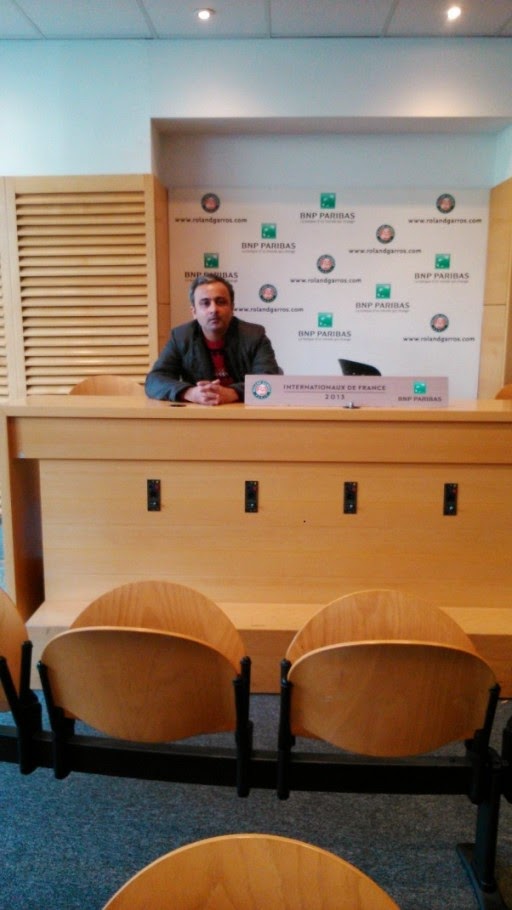

(Beneath that sweater and coat is a left arm to rival this one here. You’ll have to take my word for it.)

Near the locker rooms, a wall with some of the players’ signatures (two Federers and one Nadal included).


Outside the legendary Court Philippe Chatrier. Unfortunately they were in the process of preparing the ground for this year’s tournament, so I didn’t get to see any red clay, just a few craters.


And finally, being swatted by Suzanne Lenglen near the court named in her honour.

If Miss Lenglen’s pose reminds you of Mrs Bates with her knife, welcome to my inner world.

Sabtu, 01 Februari 2014

Rafa the low-born (tennis at Kurukshetra)

Had to share this. I wrote a piece for the magazine Indian Quarterly recently, about a new crop of epic retellings being done in popular genres such as young romance and the underworld thriller. The piece – which centred on two new books about Karna, one of my childhood literary heroes – ended with a jokey line about how, if I ever did a Mahabharata-retelling myself, I would merge my personal obsessions and present the Kurukshetra war as a series of Grand Slam tennis matches: 128 warriors, falling by the wayside one by one (over 18 days, or over a fortnight), all of it leading up to a grand finale - the decisive Arjuna-Karna battle, cast as a meeting between Roger Federer and my favourite sportsperson Rafael Nadal.

It was a throwaway reference, not central to the piece in any way, so imagine my surprise when I saw a PDF of the story and found that the illustration done for it brought together Karna and Rafa (dressed in Wimbledon whites, including the sleeveless kavacha he wore until a few years ago) in one surreal, bow-and-bandana juxtaposition. I didn't have anything to do with planning the image, so this was most fortuitous, and I must thank the illustrator Salil Sojwal. Here’s the picture:


Illustration: SALIL SOJWAL

Of course, one is now tempted to make Nadal: Federer = Karna: Arjuna analogies, based on nothing more concrete than the facile perceptions we form of sportspeople. Thus, Roger as the privileged prince and favoured son, all grace and artistry, seemingly born to conquer the world, his destiny pre-written in stone; and Rafa as the dark cloud on his horizon, the upstart shaking up the fraternity with his unconventional style of play and his apparently uncouth mien (which conceals a sweet but defensive nature). Roger pirouetting his way across tennis courts with a sense of entitlement, while Rafa plays catch-up, struggling with the slings and arrows of outrageous fortune: chronic injuries, a style of play that doesn’t meet the aesthetic demands of people who want their tennis to be like ballet, and an inability to make himself properly understood – which in one famous case after the 2006 French Open led to public booing because he had been mistranslated. (“Chale jao, suta-putra,” yells the Hastinapura crowd.)

I could go on, but I won’t. Instead here are two photos of cho-chweet bonding between rivals. The first is from the great years of the Roger-Rafa bromance (more on that in this post); the second is from a recent episode of the Star Plus Mahabharat where Karna helps Arjuna (disguised here as a brahmin) lift a chariot wheel out of the mud (!!). Can't see the resemblance? Either there is no poetry in your soul, or you have better things to do with your time.


"
"VAMOS!!!"

Rabu, 11 September 2013

13 and 6 (some thoughts after Rafael Nadal’s US Open win)

[Statutory warning: indulging myself with a tennis post – the sort I would happily write two or three times each week, if I had the time and was doing it professionally. Did a version of this for Business Standard Weekend. Ignore if you haven’t followed men’s tennis in the past decade]

One hazard of being both a fixated tennis-watcher and innately interested in numbers is that odd combinations of match scores and player statistics swirl about in your head, keeping you awake nights. For example: in my long, eventful fandom of Rafael Nadal, there have been two key occasions – both on the eve of a Slam final – when I have dwelled upon the formula “12 versus 6”, expecting it to become “12-7” the next day but secretly hoping it would be “13-6”. In both cases, the hope was pleasingly and unexpectedly realised.

1 ) nearly five years ago, before the 2009 Australian Open final between Rafa and his great rival Roger Federer, the head-to-head between the two players was 12-6 in Rafa’s favour. I’m not one of those Nadal fans who point to the lopsided H2H as evidence that Rafa is “better” than Roger, but I admit to getting some satisfaction from it, thinking of it as part of his overall legacy. And in January 2009, I had resigned myself to Federer winning that final. The counter in my head had already ticked over: “The head-to-head is going to be 12-7 now,” I told myself. “C’est la vie.” Well, as any tennis follower knows, that didn’t happen. 13-6 happened instead.

2 ) last weekend, when Nadal and his greatest current rival, Novak Djokovic, won their US Open semi-finals and prepared to play each other for the trophy, a different sort of head-to-head comparison came into play. Nadal had 12 Slam titles, Djokovic had 6. Which meant that at the end of the match, the comparative Slam-count would be either 13-6 or 12-7. Midway through the match, I was convinced Djokovic had the thing wrapped up. Always dangerous against Rafa, he had raised shot execution to the level of intent, and some of the rallies were resembling highlight reels from their meetings in 2011, when Djokovic beat Nadal six straight times. But again, Nadal found a way and 13-6 it was.


Yes, this coincidence of numbers is an obscure thing to go on about, but I'm using it to make a couple of points. First, these matches were against Nadal's most important opponents, the two other top male players of the past decade (but more on that later). Second, it could be argued that he had no business winning either of those matches. Two days before that Australian Open final against Federer, he had played an intense, debilitating five-hour semi-final against Fernando Verdasco, and he would later write in his memoir that he never thought he would recover in time for the final. (I believe him: in Chennai the year earlier, Nadal played a marathon three-set semi against Carlos Moya, and then, depleted, mustered just one game in the final the next day.) Meanwhile, Federer had been stunningly imperious – even by his own standards – in his quarter-final and semi-final, and had had an extra day’s rest. Even given the nature of the match-up, which favoured Rafa, there was no reason to think he could win his very first hard-court Slam final against one of the finest hard-court players of all time.

Watching him pull that off – and then watching him, earlier this week, finding a way to meet Djokovic’s flashes of un-playable-ness with his own solidity and counter-aggression – have been just two in a long line of happy surprises that have come with being a longtime Nadal follower.


Constantly being surprised – that is what Rafa fandom has been like, at least for a diffident, forever-hoping-for-the-worst fan like me. The goal-posts for what is possible, what can realistically be achieved, have kept changing. Back in 2006, I was surprised when he beat Federer at the French Open final (it was the first time Rampaging Roger had ever lost a title match at a Slam) because I thought it was pre-destined that Federer would complete his Career Slam that year. Then I was surprised when Rafa won his first major off clay, at the historic 2008 Wimbledon final.

I was surprised when he won a hard-court major, surprised when he made a brilliant comeback in 2010, following a disappointing few months affected by injury. And now, in the second half of his career, at a point where he should rightly be starting his decline (a player who first became a Slam-winner nine seasons ago can usually be expected to be past his peak), I have been astonished both by his comeback this year (10 titles in 13 tournament appearances, a 17-1 record against top 10 players) after another injury break, and by the fact that he has been able to win important hard-court matches against Djokovic.

But then Nadal often seems surprised by himself too: as he said of Djokovic after the USO final, “Sometimes I really don’t know how I am able to beat him.” I have written elsewhere about the sandbagging – or the public lowering of expectations – that he is often accused of (“I have to play my very best to have a chance to win,” he often says in interviews before facing an opponent ranked several dozen spots below him). It’s an attitude I personally relate to, but more to the point, it is an understandable one given the many physical struggles he has had - notably with congenital foot and knee issues - over his career, and the fact that he has frequently had to play catch-up on surfaces other than his favourite clay.


Djokovic has long been an important part of this story. In 2008, when he first emerged as an A-plus-level player, seriously challenging Rafa’s hold on the number 2 spot behind Federer, I read a long, thoughtful comment on a tennis website suggesting that Rafa was destined to be a brief interlude between the Federer Era and the Djokovic Era, a clay-court champ whose short career would be sandwiched between those of two all-time greats of the sport; at best, perhaps, he would achieve something akin to Lleyton Hewitt, who honourably commandeered the ATP fort for a season and a half between Pete Sampras’s decline and Federer’s rise. And this view seemed reasonable enough: Nadal hadn’t won a Slam off clay yet, and Djokovic (who Pete Bodo had described as “the perfect player” as early as 2007) seemed a more complete, all-round, all-surface champion.

What has actually transpired over the years is – again from the viewpoint of a perpetually pessimistic fan – quite wondrous. Nadal has continued to be not merely relevant but often dominant in his individual rivalries against Federer and Djokovic, weathering storms when each of these players were in prime, world-conquering form. And while being a game-spoiler for both of them to varying degrees (they would both have had even more impressive records if the Spaniard had not existed), he has also presented them with new challenges and made this entire tennis era seem a little more charged up and intriguing than it may otherwise have been. As a sandbagging fan, I’m only just starting to deal with the idea that there might actually have been such a thing as the Rafael Nadal Era, and that we may have been in it for the past six or seven years (and this is said with no disrespect to Federer – who I still regard the better overall player – or to Djokovic). 


****

About something more specific: there has been some talk recently about Nadal’s shift to a more attacking style of play on hard courts, a style tailored to make his game more efficient and help protect creaky limbs on a playing surface he has never been particularly fond of. This change, I think, is also showing in his demeanor on court, in displays of relaxedness that are different from the way he normally is in the heat of competition.


For instance, in the fourth set of the USO final, when Rafa was up 3-1, serving at 30-15, he sent down a first serve that was called out, then decided to challenge the call (asking for a replay on the Hawkeye system) – but he was simultaneously shrugging to himself and getting back into his serving position as if to say “I know it probably was wide, but might as well check.” This casualness was atypical, I thought. After all, the match was by no means over. He was only one break up, against a dangerous, unpredictable player famous for making comebacks; there had already been breaks of serve in games where the server had initially seemed in control; and if the challenge was wrong (as Rafa seemed to know it was), it would mean that he had interrupted his own playing rhythm just before a crucial second serve. But all that didn’t seem to matter: it felt like he knew he essentially had things in hand. Shortly afterward, still a few points away from the win, he was trotting about the court looking more laidback – even smiling a little – than I can ever recall seeing him in a similar situation.

Perhaps this comes out of having been out of the game for several months, not knowing if he would be able to come back or play at a high level again – and consequently just being grateful for whatever chances he gets. Whatever the case, if that’s the attitude we see in the next few months, I’ll take it – with fingers crossed, of course, that the knees can keep pace with the extraordinary mental strength.

[Some earlier tennis pieces: on rivalries and fan narratives; the war within Rafa; a review of Nadal's memoir]

Selasa, 25 Desember 2012

Lekin...

There is much to enjoy in In the Company of a Poet, Nasreen Munni Kabir’s series of conversations (conducted mostly on Skype) with Gulzar. The poet/lyricist/filmmaker speaks at some length about his childhood, his writing career and his experiences in the movie industry, including his association with such personages as Bimal Roy, Meena Kumari and Hemant Kumar. But what stopped me in my tracks was when I read about Gulzar’s tennis-love. “You know, I play tennis every morning and the very thought of an Urdu poet wearing shorts and playing tennis goes against the grain,” he remarks at one point, “Ye Urdu ke shaayar hain aur subah ye knickers pahen ke kaise khelte hain?”

Shortly afterwards comes this poetic metaphor:

I wake up at five when it is still dark. I want the sun to look for me instead of my looking for the sun. Just as the first serve in tennis can be advantageous, so the first serve must be mine. The second goes to the sun.
And still later, this bit, which left me feeling not very gruntled.
I enjoy the way Federer plays. He is cool and has a gentle smile. The only thing I have against Nadal is the villainous grimaces he makes.
As a poet, Gulzarsaab should know that one may smile and smile and be a villain. Ah well. Just goes to show that it isn’t easy to be a creative genius AND a discerning sports fan. (In any case, Rafa chooses to serve second when he wins the toss. Everyone knows that.)

[Two pieces about my Nadal-fandom here and here]

Senin, 26 September 2011

Rafa: the pros and cons of a mid-career memoir

[Okay, this is my last piece on tennis for some time - a review I did of Rafael Nadal's autobiography for Business Standard. Some earlier thoughts on Nadal and the book are here]

Sporting careers follow a different trajectory and time-scale to most others. Since a top player in a physically demanding sport may well retire at age 30 or less, having already achieved most of the things he will be remembered for, there’s nothing unusual about an athlete having a memoir out at a relatively young age. But some debate can be expected when a sportsman’s autobiography arrives while his career is still active and near its peak. And so, the first question that must be asked about Rafael Nadal’s life chronicle Rafa is: why now?

One obvious answer is that last year, at the age of just 24, Nadal became the youngest male tennis player to complete the Career Slam – that is, winning all four majors (the Australian Open, the French Open, Wimbledon and the US Open) at least once. That’s a prestigious enough achievement in itself, but the context made it more dramatic. A year earlier, injuries, family troubles and apparent lack of mental focus had combined to put a question mark against Nadal’s longevity; many journalists and viewers had sounded the death knell for his career. This made his resurgence – and the solidification of his status as one of his sport’s best players – even more impressive.

In our age of instant information and round-the-clock media scrutiny, it must have seemed natural to come out with the “official”, inspirational story. Rafa covers various aspects of Nadal’s life, but the narrative is anchored around the two defining matches of his career: the celebrated 2008 Wimbledon final against his great rival Roger Federer, which saw Nadal win his first non-clay Slam and take a big step towards claiming the number one ranking; and the 2010 US Open final win – against another worthy rival Novak Djokovic – which completed the Spaniard’s Slam collection.

Though we’re told that this book is authored “with” journalist John Carlin, it’s safe to assume that the writing is entirely Carlin’s. For one thing, Rafa isn’t exclusively in the first person; alternating with its main narrative are short, “objective” chapters that provide an outsider’s commentary on Nadal and his inner circle. Also, the refined coolness of the writing (phrases like “the cathedral hush of Wimbledon’s Centre Court” and “I didn’t expressly prohibit them from raising the subject” appear in the first couple of pages) will initially be distancing for anyone familiar with Nadal’s spoken English (“He play better than me – that’s the true, no?”). But as you read on, it works because it reflects the inner clarity of a contemplative, grounded sportsman.

This comes across most vividly in Nadal’s reflections on the day before a big match, and the hours leading up to it: about chatting with family over dinner and pretending it’s a normal day, though everyone knows he has already started playing the match “in a space inside my head that should remain mine alone”. Or how, when he finds himself alone with Federer in the locker room a few minutes before a final – just the two of them in a spookily quiet space that housed 128 players a fortnight earlier – he settles for a quick handshake. (“To joke or chatter about football, as we might before an exhibition match, would have been a lie he would have seen through immediately and interpreted as a sign of fear.”)

A major talking point around any mid-career memoir is what a sportsperson should or should not disclose while he is still playing. Nadal has been prone to recurring injuries, which get extensive media coverage. His supporters point out that like many other athletes, he plays through the pain and is often good enough to win tournaments despite his ailments; but there has been a rising belief that injuries are used as convenient excuses for losses, or that his frequent medical time-outs are ploys to throw off an opponent’s rhythm. Even those who are inclined to give him the benefit of doubt have gently suggested that he might be turning into a bit of a hypochondriac; recent incidents such as the one where grabbing a hot plate in a restaurant led to nasty finger blisters, or the unfortunate attack of cramps during a US Open press conference, have been the subjects of much Internet humour.

Perhaps with an eye on this negative publicity, Rafa tries to set the record straight, providing medical details about the congenital foot disease that almost ended Nadal’s career in 2005, and the effect it had on his subsequent physical and mental conditioning. An obvious downside to making such revelations is that it might give rivals extra information as well as motivation. But this is clearly a risk he has opted to take.

Other highlights include Nadal discussing the ups and downs of his relationship with the only coach he has ever known, his paternal uncle Toni – a hard taskmaster who helped channel his nephew’s famous mental strength, but who may have been excessively harsh on occasion. These passages have received much press coverage, most of which makes the book sound more controversial than it is, but when you read them as part of a larger narrative they don’t seem so shocking. The overall impression here is that of a young man who is still highly dependent on family (Nadal lives in a multi-storeyed house with his large clan) but who is also becoming conscious of the need to speak his own mind and break out of a parochial image.

All this adds up to a book that has many candid interludes mixed with some bland reportage and superfluous chronicling of career highlights. But in any case, Rafa might already be somewhat dated. When it was written, Nadal had just come off his finest season and it seemed his position at the top would be secure for some time, but things are no longer so rosy. He has had a fine 2011 by most standards, but he has been a distant second-best this year, having been overshadowed by Djokovic.

Whether this marks the beginning of a permanent decline or motivation for another comeback remains to be seen. Either way, there’s no doubt that Nadal will update this autobiography – or write a new one – when his career ends. The revised version, written with the benefit of distance, should be even more revealing.

[Finger blisters photo credit: Nadal News]

Senin, 12 September 2011

Rafa: the war within?

It’s difficult to gauge exactly how one forms a connection with a particular sportsperson – fandom is a thick brew made up of many secret ingredients – but one possible explanation for my interest in Rafael Nadal’s game and personality presented itself last year...

To read on, go here. This is a piece I did for First Post - it's about Rafael Nadal as perpetual underdog, my own identification with an aspect of his personality, and the frank self-analysis in his new autobiography. Of course, it's a bit ironical that this piece is appearing just as Rafa is almost certain to lose the US Open final to his 2011 nemesis Novak Djokovic (being a masochist, I will be up watching the match later tonight), but that's how things go in sport.

P.S. For any regular blog-readers with feedback on the piece - I'd prefer you leave comments here, not on the First Post site.

[Two earlier tennis-related pieces: From a Rafa fanboy and Deuce: On tennis narratives and rivalries]

Kamis, 08 September 2011

Deuce! On tennis narratives and rivalries (and Steve Tignor's High Strung)

[Did a version of this piece for Forbes India. Here's the - slightly shorter - magazine version]

Nearly every time I hear or read (or participate in) a sports-related discussion, I’m reminded of a single-panel comic I saw once on a website. “A weighted random number generator just produced a new batch of numbers,” one stick figure says. “Let’s use them to build narratives!” replies his companion.

The descriptor at the bottom? “All Sports Commentary.”

Building narratives is something sports fans spend a lot of time doing; one can argue that sports-watching wouldn’t be much fun if we didn’t do it. We are all guilty of reading too much into statistics, or tossing off smug statements about this or that player. (Try counting the number of times you’ve heard the remark “He can’t handle pressure”, made about someone who has been ranked in the top 10 of a sport for years.) In cricket, when a strike bowler gets a star batsman out a few times – even if a couple of those dismissals were lucky – it becomes accepted that the former is “in the latter’s head”. We think we know what is going on in the minds of our favourite players, and we make whimsical connections between athletes who lived decades apart. Even the more balanced, self-aware viewers frequently succumb to the human tendency to see patterns.

Aiding us in this is the sports media, which specialises in creating stories with a dramatic arc (they’d be out of a job if they didn’t). Thus we regularly get eye-catching headlines about eras ending and batons passing rapidly from one champion to another – when in fact sports history is more often marked by slow, incremental changes. The careers of top players overlap for long periods; a champion may begin his decline or get overtaken, but then return for a last hurrah when no one expects it. When he entered the 2002 US Open, Pete Sampras had gone 33 tournaments without a title – the “Sampras Era” was well and truly over – but he won that trophy against all expectations. Jimmy Connors reached the semi-finals of the 1991 USO at age 39, eight years after his last Slam win and more than 15 years after his peak. Sporting narratives are rarely cut and dried.

All that said, it’s easy to see why so many tennis experts consider the 1981 US Open a historically significant tournament, and the end of an important era in the men’s game. It was the last major, or Slam, played by Bjorn Borg, who had been the dominant male player of the previous few years. Borg's rock star-like status had defined the first decade of the Open Era, a period when the sport’s class division came to an end and some drastic changes did take place. And his own career, unlike those of most athletes, ended on a genuinely dramatic note: shortly after losing the USO final to his younger rival and nemesis John McEnroe, he announced his retirement, aged only 25.

It’s no surprise, then, that Stephen Tignor – one of the best tennis writers at work today – has written a book that dwells on the 1981 USO as the culmination of a dynamic decade, as well as a harbinger of the decade to come. But in looking at the period through the prism of its most celebrated rivalry, Tignor’s High Strung also recognises that the friction between great competitors is what makes sporting contests so compelling.

The Borg-McEnroe story had every element you’d want from a dramatic storyline – not least an attention-grabbing contrast in personalities. Anyone familiar with Tignor’s work for Tennis magazine will know that he is a writer with a real head for nuance, but even he can’t resist titling the first chapter of his book “The Angel and the Brat”, and setting one legendary persona against another: Borg the Ice Man, under whose imperturbable surface burnt hidden fires, versus McEnroe the Superbrat, perpetually on edge, scourge of umpires and genteel viewers. Weaving in and out of this story is the other top player of the time, and the Open Era’s first blue-collar brat: the mercurial Connors, who had separate intriguing rivalries with Borg and McEnroe. But there’s no question who the two protagonists are.

There is a temptation in sports writing – particularly in individual sports – to cast major rivals as doppelgangers with an almost mystical bond; as players who form an ambivalent relationship as they come to realise that their names will always be linked together. Describing McEnroe’s pursuit of Borg, Tignor writes: “At its deepest psychological level the match was a case of a little brother trying to slay a big brother, an acolyte attempting to kill an idol.” McEnroe had looked up to Borg, holding him as a personal standard, ever since he had served as a ball-boy during one of the Swede’s earliest matches; for him, the only truly meaningful way to reach the apex of his sport was by conquering his idol.


This romantic view of sporting conflict has it that Borg’s sudden retirement was a case of a champion crushed by the emergence of a rival capable of beating him. But Borg’s exit was equally the result of well-chronicled factors in his personal life. Even before McEnroe became a serious threat, there had been signs that the reticent Swede was being worn down by the grind of the celebrity life; twenty-five may not have felt very young to someone who, making his Wimbledon debut at 17, had been assaulted by hundreds of screaming schoolgirls in the first manifestation of a decade-long phenomenon called the “Borgasm”. (See photo near the end of this post.)


Even so, the rivalry was majestic on sporting grounds alone. Borg’s frustratingly consistent, error-proof baseline play contrasted well with McEnroe’s fine touches and all-court artistry – they played two classic five-set Slam finals in 1980, and their head-to-head record would end at seven matches each. After McEnroe swiped the Wimbledon title from Borg, it seemed almost predestined that Borg would return the favour at the USO. But that didn’t happen. And so, Bjorn Borg – who still holds the record for the highest percentage of Slam matches won – walked away defeated from his last major. For the sport – which had the young future champion Ivan Lendl waiting in the wings, as well as a new era of graphite racquets to come – it was an end and a beginning.

****

This month’s edition of the US Open marks exactly 30 years since that fateful tournament, and once again we narrative hounds are on the scent of a Big Story. The interim decades did see a number of intriguing rivalries in the men's game – most notably the ones between Sampras and Andre Agassi, and between Stefan Edberg and Boris Becker – but they were relatively low-intensity or confined to specific venues; both players were rarely at their absolute peaks at the same time, and one never quite had a sense of big things at stake for the sport. However, the past few years have seen a rivalry that in some ways has eclipsed even Borg-McEnroe. And there are signs that the era it defined is ending.


For nearly seven seasons – a vast stretch of time in an athletic sport – tennis lovers have been riveted by the saga of Switzerland’s Roger Federer and Spain’s Rafael Nadal. Federer has overtaken Pete Sampras’s Slam record and set new standards for tennis dominance, holding the number one spot for 237 consecutive weeks and reaching an incredible 23 straight semi-finals at majors (for comparison, Sampras never made more than four semis in a row). But even in his peak years, the one player the Swiss could never dominate was Nadal, whose defence-to-offence baseline play, mental tenacity and powerful top-spin seemed almost laboratory-created to break down Federer’s more subtle game. In Federer’s greatest year, 2006, he lost just five matches in all – and four of them were to Nadal, all in finals, and most of them on clay, the surface where the Spaniard was best able to exploit the advantages his left-handed forehand gave him against Federer’s one-handed backhand.

Between them, these two men won 23 of the 26 majors that were contested between the 2004 Wimbledon and the 2010 US Open, and they maintained a stranglehold on the top two ranking spots for most of this time – a duopoly unprecedented over any comparable period in tennis history. In just five years, they played each other in a record eight Slam finals, on all surfaces. (The leading rivals of the 1990s, Sampras and Agassi, contested five finals over a 12-year period.) And there have been irresistible parallels with Borg-McEnroe: Borg took his fifth straight Wimbledon title in 1980, winning a classic five-setter against the young McEnroe; Federer won his fifth straight Wimbledon in 2007, beating off a similar challenge from Nadal; and in 1981 and 2008 respectively, the younger man reversed the result.

There are other similarities. At one point, Tignor suggests that McEnroe was at his best when he was the hunter, not the hunted – when he had a player ahead of him, whom he could run down – and that he was never quite the same after Borg had retired. Many have said exactly the same thing about Nadal, who appeared more carefree when he was ranked number two than when he took over the top spot. Perhaps he needed the mountain of Federer ahead of him.

But sporting comparisons are never so facile, and there is simultaneously a counter-narrative that casts Nadal as the modern-day Borg. There is a thirty-year age difference between these two champions, almost to the day, and both were teenage superstars. Like Borg, Nadal is a master of the natural surfaces, a clay-court monster (he recently equalled the Swede’s record of winning six French Opens, on the surface where it’s hardest to sustain excellence over a period of time) who successfully adapted his game to grass. The words used by Time magazine to describe Borg in 1980 – “an inexorable force that is one part speed, one part topspin and two parts iron will” – read like a sketch of the Spaniard.

Neither man ever seemed as comfortable on hard or synthetic courts: Borg’s Waterloo was the US Open, where he finished as runner-up four times; until last year it seemed like the same would be true for Nadal, but he completed his career Slam by beating Serbia’s Novak Djokovic in the US Open final.

Now, however, the same Djokovic is threatening to end the Federer-Nadal era. He has utterly dominated the men’s tour this year, beating Nadal in five finals, and the events of the past few months have raised the question: is history being rewritten on the 1981 palimpsest? Nadal is now 25 – the same age that Borg was when he abruptly hung up his racquets. Could it be that Rafa now has a “McEnroe” of his own?

****

Ultimately, these stories can be spun in many different ways. What’s more interesting is how tennis rivalries – and our perceptions of them – have altered in the past three decades. In the Internet age, sports fandom is more intense and in-your-face. Everyone has not just an opinion but a public forum to immediately express it in; fans around the world can access even the smallest tournaments and discuss matches “live” on message-boards. Everyone becomes a psychologist when it comes to analysing the behaviour of their favourite – and least favourite – sportsmen. Thus, Federer fans see him as humble while his dislikers proclaim with equal confidence that he is unbearably arrogant. Nadal’s on-court mannerisms such as the vigorous fist pumps and shouts of “Vamos!” are decried by those who don’t care for his playing style, but his fans point out that these self-motivating gestures are never directed at his opponents, and that he is well-behaved off the court.

Leading players have always been cast into images that are impossible to break out of. Borg, for instance, was mythologised as having a resting pulse rate that never rose above 35 – a claim that is about as accurate as the one that he had ice in his veins. High Strung indicates how this reputation developed (“a two-inch dip in his chin after a missed shot was the equivalent of a racquet hurled over the fence for most players ... if he stared for a not-absolutely-necessary extra split-second at a line judge after a close call, it had approximately the same effect as a 10-minute profanity-laced tirade from McEnroe”), but there are also vignettes that show another side to the player – such as a remarkable photograph of a young boy looking more shy (and dazed) than aloof as police keep hordes of those schoolgirls away from him.


Simplifications have also plagued the Federer-Nadal-Djokovic rivalries. Nadal has been labelled the unrelenting “bull” (zoopomorphizing a Spanish athlete thus is an ancient tradition in sports writing), while Federer is the ballet dancer with the smooth and seemingly effortless game. Djokovic’s name has only just entered the great-player discussions, but a few years ago he drew attention for his locker-room imitations of other players’ mannerisms, including Nadal’s butt-picking gesture. This writer (a big Nadal fan) thought them funny, but people with thinner skins saw the imitations as disrespectful. At any rate, the Serb’s reputation has been fixed for all time in some minds: as the Djoker.

There have, of course, been positive changes in our perceptions too. Tignor’s book reminds us that Borg and McEnroe were friends off-court, but for most fans the dominant image of their rivalry is that of an undemonstrative or even sullen handshake at the net. Today, however, there is so much more coverage – not just on official media but through fans’ reports, photographs and videos – that we are constantly exposed to the goofier sides of players. We see them fooling around at exhibitions, participating in musical sideshows on the eve of a tournament, or having a casual courtside chat shortly after a seemingly acrimonious match – and so it becomes more difficult to sustain notions of deep hatred between rivals.

It helps that today’s top players have consistently been fine sportsmen – or “good boys”. The mutual respect between Federer and Nadal in particular contrasts strongly with the acrimony that dotted some player relationships in the past (and their hugs at the net have even spawned homoerotic online fan fiction that would have had Connors and McEnroe barfing into their racquet bags – but I’ll let that pass for now).

At this point, though, tennis belongs to neither Nadal nor Federer. With a 53-1 win-loss record for the year (at the time of writing), Djokovic is the clear favourite to take the US Open title. If he does (which will mean winning three out of four majors in a calendar year – something Federer and Nadal have both done in recent times but such greats as Borg, McEnroe and Sampras never achieved), it will be possible to speak of 2011 as another major shift in the sport’s history.

And then the weighted random number generator will probably kick in again, and we’ll have a completely different narrative to follow next year.

Rabu, 15 September 2010

Enuffa of Ruffa?

Okay, I have neither the time nor the energy to write a proper post about Nadal's US Open win, but suffice it to say that the two sleep-deprived nights in a row (the first spent waiting desperately for updates about the New York rain situation starting at 2 AM India time, the second with the match again prolonged by a rain interruption) were completely worth it. (Not to mention the tense 24 hours in between, when I was convinced that the extra rest day would help Djokovic win.) If you read this post from a couple of months ago, you'll see that I was more than happy - at the time - to see Rafa regain his French Open title and sweep the clay season. What's happened in the two months since has been well nigh unbelievable.

It's also made me feel slightly ambivalent as a fan. My initial interest in Nadal's game (as expressed in this post from 2006) had a lot to do with his role in keeping men's tennis from being completely dominated by one player. But now that he's had a Federer-like, three-Slam year of his own, I wonder if I should shift my allegiance to some else. Or start following women's tennis instead.

Pure rhetorical speculation, of course. Vamos! and all the rest of it.