cooltext1867925879

~~ Mudahnya peluang usaha ~~

SUSU KAMBING ETAWA BUBUK 2015

E.A.P Teknologi BPTP YOGYAKARTA

header

1419847472700532415 ETAA  

Untuk itu awali tahun baru Anda dengan berwirausaha dan kembangkan bakat kewirausahaan Anda dengan bergabung bersama

header

~~SUSU KAMBING ETAWA BUBUK Ijin Edar LPPOM 12040002041209 E.A.P Teknologi BPTP YOGYAKARTA ~~

Halal MUI

Ibu Eri Sulistyowati Telp/sms 089651095115 Pin 28823f03

~~ PELUANG USAHA 2015 ~~ SUSU KAMBING ETAWA BUBUK ~~

  1. Bisnis paling menjanjikan dengan laba 100% milik sendiri tentunya akan sangat menarik untuk dijalani. ~~ SUSU KAMBING ETAWA BUBUK ~~
  2. sebuah usaha kemitraan yaitu ~~ SUSU KAMBING ETAWA BUBUK ~~
  3. membuka sebuah penawaran paling hot di Awal tahun 2015 yaitu paket kerjasama kemitraan dengan anggaran biaya @20.000 /kotak' (partai ecer) Untuk grosir bisa MendapatkanHarga hingga @15.000 WOOOW dengan mendapatkan benefir semua kelengkapan usaha.
  4. Anda bisa langsung usaha ~~ SUSU KAMBING ETAWA BUBUK ~~ dengan investasi yang ringan.
  5. Pada tahun 2015 banyak diprediksi bahwa usaha ~~ SUSU KAMBING ETAWA BUBUK ~~ masih sangat menjanjikan.
  6. Disamping pangsa pasar yang luas jenis usaha ~~ SUSU KAMBING ETAWA BUBUK ~~ juga banyak diminati. Konsumen yang tiada habisnya akan banyak menyedot perhatian bagi pemilik investasi.
  7. Untuk itu jangan buang kesempatan ini, mari segera bergabung bersama kami dan rasakan sendiri manfaat laba untuk Anda.

Tunggu apalagi, ambil telepon Anda dan hubungi kami melalui sms,bbm maupun email susukambingeta@gmail.com. Jika Anda masih ragu, konsultasikan dahulu dengan kami dan akan kami jelaskan mekanismenya. Proses yang sangat mudah dan tidak berbelit-belit akan memudahkan Anda dalam menjalani usaha ini. Kami tunggu Anda sekarang untuk bermitra bersama kami dan semoga kita biosa menjadi mitra bisnis yang saling menguntungkan. Koperasi Etawa Mulya didirikan pada 24 November 1999 Pada bulan Januari 2011 Koperasi Etawa Mulya berganti nama menjadi Etawa Agro Prima. Etawa Agro Prima terletak di Yogyakarta. Agro Prima merupakan pencetus usaha pengolahan susu yang pertama kali di Dusun Kemirikebo. Usaha dimulai dari perkumpulan ibu-ibu yang berjumlah 7 orang berawal dari binaan Balai Penelitian dan Teknologi Pangan (BPTP) Yogyakarta untuk mendirikan usaha pengolahan produk berbahan susu kambing. Sebelum didirikannya usaha pengolahan susu ini, mulanya kelompok ibu-ibu ini hanya memasok susu kambing keluar daerah. Tenaga kerja yang dimiliki kurang lebih berjumlah 35 orang yang sebagian besar adalah wanita. Etawa Agro Prima membantu perekonomian warga dengan mempekerjakan penduduk di Kemirikebo.

~~ Mudahnya peluang usaha ~~

SUSU KAMBING ETAWA BUBUK 2015

Ibu Eri Sulistyowati Telp/sms 089651095115 Pin 28823f03

~~ PELUANG USAHA 2015 ~~

~~SUSU KAMBING ETAWA BUBUK ~~

cooltext1867925879
apk free app download: dogs
Tampilkan postingan dengan label dogs. Tampilkan semua postingan

Selasa, 29 Juli 2014

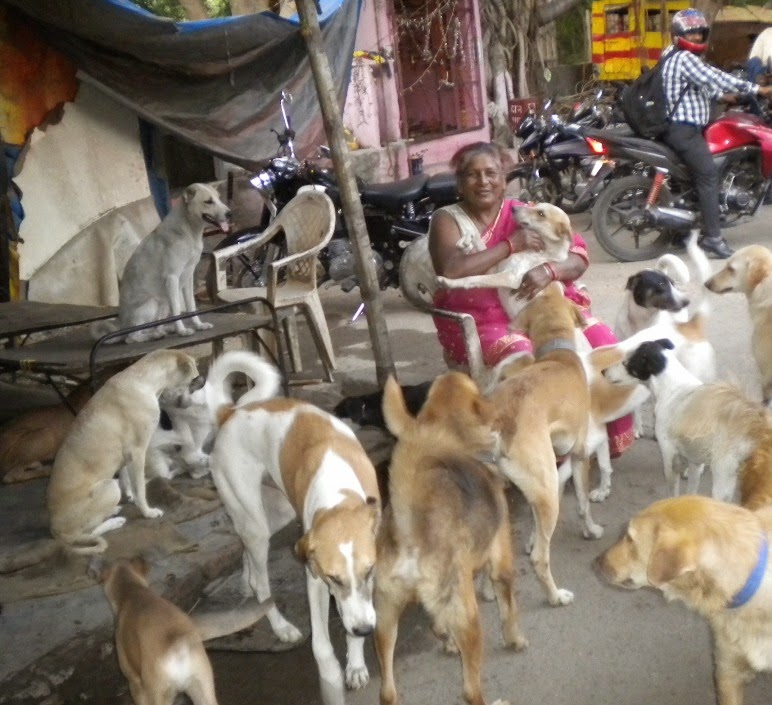
Help needed for Pratima Devi and her dogs

Anyone who has contacts among animal-welfare NGOS, please do help or circulate. Pratima Devi a.k.a. Amma, the beautiful old woman who looks after street dogs near the PVR Saket complex, needs a full-time assistant to stay with her and help her with the feeding of the dogs and other related things (treating injuries, being around when the van comes to take them for sterilising, and so on). She had a couple of boys who were helping out, but they left, and often being in poor health herself, she needs someone who is reliable, sensitive and needless to say, a dog-lover. A decent salary will be paid, of course (this is something a few of us are trying to help out with), and there is enough sleeping room (and even a small cooler) in Amma’s shack.

The best place to look for someone appropriate might be an NGO, but if you know someone else who might fit the bill, please do get in touch. My email ID is jaiarjun@gmail.com, or you can leave a comment here.

[More about Pratima Devi here and here]

Selasa, 04 Februari 2014

Kitty litterateurs: on Suniti Namjoshi's Suki and other cat books

[Did this for the magazine Democratic World]

There was an email forward doing the rounds recently, a comparison of hypothetical one-page diary entries written by two house pets – a dog and a cat. The dog’s entry was short, semi-literate and full of sunshine and cheer, with such exclamations as “Oh boy! A car ride! My favourite!” and “Oh boy! Tummy rubs on the couch!” while the cat’s was written in full, elegant sentences and was sardonic and world-weary: the very heading read “Day 183 of my captivity”.

Anyone who knows the two species well should agree that this is a good summary of their broad personality types. And anyone who knows professional writers – at least the ones who brood for hours over the construction of a paragraph or sentence – will agree that temperamentally they tend to be cat-like: mostly reserved, unsocial and irritable, but willing to purr for a short time if a satisfying turn of phrase has been achieved, or a deadline more or less met. There are also practical reasons why writers are more often “cat people” than “dog people”. Dogs are dependent on human attention, needing to be regularly spoken to and taken down for walks, but cats are more self-sufficient, and hence suitable companions for people who spend much of their time in fierce concentration.


In this light, it is interesting to consider the difference in tone between books about dogs and books about cats. The former – especially the ones about life with a pet – tend to be sentimental and emotionally demonstrative, whereas cat books have a certain coolness built into them. And this can be the case even when they belong to the Motivational or Self-Help category. Take David Michie’s very engaging The Dalai Lama’s Cat, told in the voice of a kitten who is rescued by the Dalai Lama at a traffic signal near Delhi and brought to Mcleodganj, where she soon settles into the temple complex and becomes known as His Holiness’s Cat (HHC).

HHC – alternately known as Snow Lion and, to her dismay, “Mousie-Tung” – spends much of her time in the company of the Buddhist leader, soaking in his presence (“had he recognised in me a kindred spirit – a sentient being on the same spiritual wavelength as he?”) and listening in as he discusses the conundrums of existence. Each chapter follows a broad format where a human character discovers the need to rethink his attitude to things, and the cat then applies some of these teachings to her own situation, with varying degrees of success. Thus, an insight about how self-absorption can make one sick and unhappy (a valuable lesson for writers, as it happens!) is linked to our narrator coughing up fur balls after spending an inordinate amount of time grooming herself. She realises that a period of self-pity combined with fear of exploring a new setting cost her precious time that she might have spent getting to know a new friend; and she is even inspired to deal with her gluttony, a by-product of being pampered silly.

As an old cynic wary of quick-fix advice and pat life lessons, I am not really a fan of this genre. But The Dalai Lama’s Cat worked for me because even in times of emotional epiphany, the cat nature retains a certain distance. At one point HHC overcomes her feelings of distaste for a new arrival, a dog named Kyi Kyi, when she learns about his sad back-story. “We reached an understanding of sorts,” she says, but then she quickly adds: “I did not, however, climb into his basket and let him lick my face. I’m not that kind of cat. And this is not that kind of book.”


Such emotional reticence can make brief, unexpected flashes of sentimentality very effective. Suniti Namjoshi’s recently published Suki, a tribute to her deceased cat, takes the form of conversations between human and feline. They talk about such things as morality, social injustice and hypocrisy, and the tone is mostly droll, faux-philosophical and chatty (or catty). But there are deeply affecting moments too. At one point in the middle of a casual conversation, the ghost-cat remarks that towards the end of her life it had been painful for her to open the cat-flap to go outside, and the author responds with a spontaneous cry of “Oh, Suki!” And another exchange, where the cat mentions that she would have liked to meet the author’s family (who were not animal lovers), should cut deep for anyone who has ever had a special, intense relationship with an animal and been unable to share it with their human world.

At the same time, one knows that these conversations are fictional, that Namjoshi is imagining things about the cat’s inner life and rendering them into human language. And so, the book becomes as much about the author herself – it is a form of therapy, a way of examining her deepest feelings, including love, grief and regret. This is also a reminder that there are many types of cat books. Cats can be used to examine a particular milieu as in Pallavi Aiyar’s novel Chinese Whiskers, in which the adventures of two Beijing cats give us a window into aspects of Chinese society including insularity, city-dwellers’ prejudices against migrant workers and the materialism of the young. Or they can serve purely representative or symbolic purposes: Art Spiegelman’s brilliant graphic novel Maus depicts the Holocaust by drawing Jews as mice and their Nazi oppressors as cats, but there is no pretence that the book is about animals.


Even overtly cat-centric books like The Dalai Lama’s Cat don’t always try to provide a detailed picture of the feline world and its tactile sensations, which is why Nilanjana S Roy’s delightful The Wildings, and its sequel The Hundred Names of Darkness, are such unusual additions to the kitty-lit corpus. These novels try to imagine what the world might feel like to a cat, from the furniture and carpets inside a house to the smells and textures of the outdoors, or the visceral knowledge that a predator is stalking you in the darkness. And an important plot device is the concept of “linking”: the feral cats of Nizamuddin, Delhi, can transmit whisker signals to each other across vast distances, allowing them to form a network that humans around them are oblivious to. 

This should resonate with anyone who has long-suspected that there is something otherworldly about cats; that they aren’t letting on everything they know; or that they are, like the cat in that diary entry, plotting something diabolical. “When my cats aren't happy, I’m not happy,” the poet Shelley said once, “because I know they’re just sitting there thinking up ways to get even.” Or to telepathically work themselves into the next book or poem.

[A post about Suniti Namjoshi's The Fabulous Feminist is here]

Sabtu, 17 Agustus 2013

Fox troth - a column about hidden senses

[Did a version of this piece for Kindle magazine’s anniversary issue about sensory experiences that sometimes remain hidden from us, or that we don’t open ourselves to. I hadn’t intended to write about Foxie for a while – not for official publication anyway – but this seemed to fit the subject, so I drew on some of the things I have written earlier. The magazine website is here, and the illustration on the left is by Soumik Lahiri]


----------


It was a magical moment, one I often relive and dwell on. One afternoon in July 2008, walking towards a rough lane behind our building to check on our water booster, I saw a litter of six tiny puppies sleeping together. Perhaps it’s relevant that I didn’t see them from a safe distance – they seemed to materialise right under my nose; I might have stepped on one of them if my eyes hadn’t been on the ground.


What I felt in those first few seconds was generic concern (I didn’t know yet that the pups’ mother was nearby, and that they were being looked after by two kindly watchmen) and perhaps the briefest tug of a heart-string. At this point I couldn’t even see them as individuals, just as a huddled-together mass of vulnerable, twitching life. Even over the next few days, as my mother, wife and I began visiting the lane, taking across milk and bread, helping the watchmen cope, I couldn’t have imagined that one of those little creatures would become mine in the truest, deepest sense of the word – not my “pet” but in nearly every way that mattered, my child – and that the next few months would see the opening up of senses and feelings that I didn’t know existed.

I could write a book, or five, on the years that followed, but here’s a summary. We got a couple of the pups adopted, three others succumbed to infection and to the wheels of careless or callous drivers, and we took in the last remaining one, who became our Foxie. Though a strong and hugely energetic dog at first, she spent the second half of her short life afflicted by an intestinal condition that necessitated monitoring her diet carefully, providing medicines with each meal, cleaning up after her six or seven times a day, and watching the accumulation of side-effects: she became ill-tempered during the bad phases, suffered from pain in her hind legs, was so emaciated that most of her ribs showed, and when I took her for a walk downstairs she spent her time not running around after a ball as she once had but sniffing around for the sort of food we had to deny her at home. Then, just when it seemed her condition had stabilised and she was regaining the old spirit, she passed away on the doctor’s table last year, aged barely four.

It was the most devastating thing I have ever faced (and even that is such an understatement, it feels almost indecent to write the sentence). Yet her short life had opened new doors of perception and feeling for me. Back in 2008, if asked, I would casually have called myself an animal lover; today I realise how misleading that would have been, and how much I still had to learn. Ever since childhood, with my mother's encouragement, I had a basic interest in other life forms, at least the ones that humans find it easy to relate to – asked what I wanted to be when I grew up, I would reply “a vet”. But the only animals I had been genuinely close to earlier had been cats, who are relatively distanced and independent, and perhaps this was a reflection of my own personality.


Fox was introverted too, by dog standards that is, but my years with her provided another dimension of experience. They taught me in the most immediate terms what it meant to be in communion with another, emotionally demonstrative being – to pick up on aspects of personality and feeling – even when verbal communication is out of the equation. And there was a practical component to the relationship that made it especially deep. Working out of home, I was around her most of the time during the long months of her illness, and my daily routine centered around her needs. I was a more hands-on, invested parent than most of the fathers of human children I know – and even some of the mothers.

I should stress that the intensity of this relationship was very much an individual thing: it hasn’t translated into comparably strong feelings for other dogs. More than a year after she went, the grieving process is still very much on. I still feel incomplete and numb, struck by panic each time I think of those last moments in the vet’s clinic; I have regular nightmares about being on a narrow ledge at a great height with her in my arms, being unsure I can hold on to her and maintain my balance at the same time. And I don’t think I can take on another such responsibility, or make such a strong emotional commitment, in the near future. But my time with her did, in a more abstract sense, heighten my sensitivity towards non-human life. The experience has been one of empathy-creation – the sort of feeling where I might see an emaciated dog with a scared, hunted look in its eyes scavenging for food on the streets and think to myself with a shudder, “That could so easily have been my Foxishka, if I had never seen that litter in the lane, or if we had been a little less concerned or more casual.” Such a notion is unthinkable, but I think it all the time.


Since Fox had a somewhat unusual, elongated body structure and because she stretched out in odd positions, we used to joke that she was many animals in one. When she nibbled on leaves with her ears down, she resembled a goat. Lying on the floor with her arms spread out ahead and her legs on the side, she could seem reptilian: lizard-like or dinosaur-like. There was an odd, camel-like undulation in her movement at other times, and she was a race-horse when she galloped in circles around the park in those precious, much-too-brief early months. When I watched news coverage of the “psychic” octopus Paul, I could imagine a skilled cartoonist drawing a picture of an octopus with a round Foxie head, the eyebrows raised dolefully. I haven’t come close to bonding with any of these creatures, but thanks to her I feel like I know them all a little better.

All that said, I don’t want to get over-sentimental about the idea of dogs as creatures whose inner lives are exactly comparable to ours. It’s natural enough for animal-lovers to project their own thoughts and emotions onto their pets, and in principle this can be a good thing: an extreme version of the empathy that allows us to relate to the experiences of a human being from another gender, class, religion or colour (and therefore linked to the concept of “speciesism” as a form of discrimination along the same continuum as racism or sexism). At the same time there is always a danger of carrying identification too far and seeing the animal purely in human terms, according to our limited sense of what emotion or self-consciousness is. And that is probably not good for an inter-species relationship.

But even if you accept that one can never really know what is going on in another creature’s mind (isn’t that also applicable to other humans?), there are strong indications for anyone who cares to look closely. Dogs who are well-loved come to acquire a very particular set of characteristics: there’s a softness in the eyes that suggests a sense of security, a feeling that nothing really bad can happen in their little world; it’s understood that frenetic tail-wagging is the correct response to the sight of any new human. At the other extreme, there is the perpetual wariness, the suggestion of fear hardened into aggression, on the face of the stray who knows he’s liable to be kicked or have a stone thrown at him. And somewhere in between, in some ways worst of all, is the cagey expression of the pet who lives in a house where people give him food and water and look after him in a detached sort of way, but where affection is in very short supply: a dog who isn’t allowed anywhere near the beds or sofas, who spends most of the day tied up on a short leash and who was quite possibly smacked hard the first time he chewed on a chair leg.

****

In an essay about the self-absorption of human beings, our smug, anthropic inability to really “see” other creatures, the speculative-fiction writer Vandana Singh pointed out that urban development is geared to weeding out the natural world from human lives; it is based on the hubris that we are exalted creatures, capable of leading autonomous lives in our concrete bubbles, never mind the consequences for the ecology and for our own health. During my time with Foxie I got a firsthand sense of the determination with which some people cut themselves off from other life forms. There were fights with residents who don’t want to see dogs in the tiny excuse for a park we have downstairs. The small but devoted group of animal-lovers in our colony – people who have taken responsibility for vaccinations, sterilisations and food – constantly face the ire of the vast majority of households.

There is a tendency, among those who don’t like animals, to get bleeding-heart about “the many human beings who are in an equally bad state – shouldn’t we do something to help them first?” There are obvious logical flaws in this argument: is this a zero-sum game? Is human welfare unrelated to that of other life? Do we need to completely eradicate all human suffering from the planet – as if that is ever possible – before we turn our attention to non-human animals? But beyond that I find this self-serving argument funny because in my experience, many of the people who use it are just as apathetic to other human beings – the ones they don’t count among family and friends, or as “equals”, or the ones they don’t expect to benefit from. True compassion isn’t a quality that can neatly be rationed out by withholding it from one species (or social class, or religion, or caste – you pick the group).


And so, maybe I should end on a somewhat upbeat note by mentioning an old woman who leads a hand-to-mouth existence but can still see and feel things that many far more privileged people can’t. Pratima Devi – “Amma” to everyone who knows her – lives in a small shack next to south Delhi’s PVR Saket multiplex, five minutes from where I stay. For nearly three decades now, though earning a meager livelihood as a ragpicker, she has been looking after dozens of street dogs in the vicinity: feeding them, getting them neutered, maintaining relations with a local vet and animal-welfare organizations. But she is very far from the cliché of the socially inept recluse who is cut off from other human beings: her warmth and openness touches everyone who comes to know her. I discovered that quality for the first time a few days after Foxie died, when, driven by a need to reach out to someone who might understand, I went across to meet her. Since then, she has been a constant reminder of what open-heartedness is, and what seeing and feeling can really mean.

[Related posts: Foxie, a remembrance; An old woman and her dogs; Temple Grandin's Animals in Translation]

Selasa, 22 Januari 2013

Amma revisited / pup in plaster

An update on Pratima Devi/Amma, who looks after dogs near the PVR Saket complex. (I wrote about her in this post.) She was very unwell with high blood pressure and fever for a few days, but that hasn’t stopped her from keeping a close eye on her dozens of wards. Just as she was recovering and getting back on her feet, one of the pups got hit by a passing bike, resulting in foreleg fractures. With the help of an acquaintance (and characteristically neglecting her own health), Amma rushed him to Friendicoes for treatment; both legs are in plaster now and the poor chap is restless and depressed about not being able to play, but he will hopefully recover in two or three weeks.


Once again, please do spread the word about her to animal-lovers in Delhi. Also: she has a new litter of pups – eight of them – born to a dog who evaded the van when it came to pick up candidates for sterilisation. They are all adoption-worthy. Here are fuzzy photos of them sleeping in a cardboard box together (you might not be able to make each one out, but hopefully you'll get a general impression of cute multipupdomness).


Jumat, 04 Januari 2013

An old woman and her dogs

Just to spread the word about one of the most amazing people I know: an old woman who lives in a small makeshift shanty next to the PVR Anupam complex in Saket (near the entrance leading to the main parking lot). Pratima Devi – called “Amma” by most of her acquaintances – has been looking after street dogs for years now, on her meagre earnings from collecting and selling reusable garbage. She feeds them, gets them sterilised through Friendicoes or other local organisations; dozens of them sleep huddled together in and around her little home – it’s a truly wondrous sight for anyone who knows how territorial street dogs are, and how aggressively they keep newcomers from encroaching on their spaces.


I’ve only actually known Pratima Devi for the past six months, though we have both been in Saket – living five minutes apart – since 1987. I was vaguely aware of her existence over the years: when passing her side of the PVR complex on winter nights, I would see a couple of charpoys with dogs on them, a bonfire burning nearby. Once or twice I saw her looking very dishevelled, yelling at someone in what seemed an ill-tempered way, and I may have formed the impression that she was a belligerent nutcase who communicated only with animals and didn’t like people.

There was a story with a very interior, contemplative tone that I read as a child in one of our Hindi textbooks – I forget the title, but the premise has stayed with me all these years, long after much of what I learnt in school has been forgotten. It was told in the voice of a privileged man who sees a poor person and wants to go across and talk – to try and understand something of this person’s life and circumstances – but finds an invisible force holding him back; some combination of self-consciousness, social conditioning and perhaps an internal prejudice that makes him believe meaningful communication with someone from such a different background is impossible.


Whatever the case, though I was intrigued by the “kutton waali amma” who was often spoken of in our colony, I didn’t make an effort to come close or get to know her. That changed last June, after Foxie went. Driven by an urge that overrode all our hesitations and procrastinations, we went across and said namaste to Pratima Devi, and were relieved to find that she was extremely warm and friendly, and most happy to talk – not just about the dogs but about her life, and ours.

As we spoke to her over the next few days, many little details emerged. She left her village in West Bengal’s Nandigram in the early 1980s, she told us, mainly to get away from her husband, a lout and wastrel. She once worked as an ayah for the family of the actor-model Rahul Dev (and is still in occasional touch with them). A tea-stall she ran in the spot where she currently lives was shut down by the MCD; later she set up a little temple against the wall near her shack – it has, in a way, legitimised her presence, made it more acceptable to the people around (including the many youngsters who park their bikes nearby and are unnerved by the dogs). One of her sons lives in Sangam Vihar, working as a mistri – she has the option of staying with him (I’ve met him, he seems a kindly, concerned chap), but she can’t leave her dogs, and besides one senses that self-sufficiency is important to her. She was awarded a Godfrey Phillips prize for “social courage” a few years ago and proudly shows photos from the ceremony to anyone who visits her. She has applied for an Aadhaar card but is puzzled by the complications of the procedure; a card was once despatched but never made it to her because she has no fixed address. (I’ve seen the application form – it simply says “Near Saket Shauchalay, PVR Complex”.) Many of the dogs have film-star names - Raj Kumar, Dharmendra - which they live up to with their strutting and preening.


Every week or so I go across and check on Pratima Devi, take some food, but hardly ever has she given the impression of being in need. When I show up and ask if I can get some bread and milk for the dogs from the nearby Mother Dairy, she nods with an indulgent little smile, as if she is doing me a favour (and of course, in a post-Foxie world, she is). Or if the evening’s ration has already arrived, she asks me to come after a day or two, or to call her beforehand to check. On one occasion my mother, cradling one of the new pups, remarked aloud that she felt like adopting this one. You’d think that Pratima Devi, given her hand-to-mouth situation, would be only too glad for people to take dogs off her hand, but she practically jumped up and said “Nahin nahin! Abhi yeh bahut chhoti hai – isse mere paas kuch din aur rehna do.” (“No, she’s too little now – let me look after her for a few more days.”)

But it isn’t my intention to paint a rosy picture of her life. One often hears clichés about the “warm smiles” of the poor – clichés built on the sentimentalising of poverty, on the self-serving myopia of the well-off person who chances to see poor people in their moments of relative comfort and tells himself “They have nothing, but look how happy they are.” I have felt strongly about such hypocrisy for a long time, so it came as a jolt to me one day when I realised I may have been adopting a similar attitude to Pratima Devi; taking for granted her apparently infinite capacity for cheerfulness and optimism.

It happened on a day I went to see her after more than a week. She was with a couple of her associates – a parking attendant and another garbage-collector – and looking more depressed and agitated than I had ever seen her. The previous few days had been particularly hard: she had been laid up with a bad fever and cold, had been unable to work or to go to INA market to buy meat for the dogs, and it happened to be one of those phases when hardly anyone had come across to see her or offer help - her son wasn’t in town either.

Moaning through a backache, describing how one of her pups (a tiny Dalmatian, abandoned by some heartless sub-human) had a festering wound and was being treated by a local doctor for an exorbitant Rs 100 a day, gentle Pratima Devi muttered and fumed, half to herself, half to us: she used maa-behen gaalis as she spoke of a man who had promised to help her secure an electricity connection through the MCD, but who had then made off with more than a thousand rupees. “Gareebon ka sab phaaydaa uthaate hain,” she wailed, her face showing no trace of its characteristic warmth and openness. She wondered aloud what would happen to her dogs after she passed on. (It’s a thought that worries everyone who knows her; though these are street dogs, they are more pampered and loved than many house pets. When she’s away even for an hour or two, they get restless and start chasing after passing autorickshaws to see if she has returned.)

This encounter was a bucket of cold water in my face. I have seen her many times since that day, and she has mostly been back to her upbeat self – but that one day, when the mask slipped, is not something to forget.

I didn’t intend this post as a call for aid, but Pratima Devi has had more bad days than good ones recently (being old and living on the street as the Delhi winter gets worse will do that), and she could always do with some help, even if she doesn’t ask for it. So do go across and see her if you are in Saket sometime, and if you like dogs. (I wouldn’t normally put in that second proviso – Pratima Devi is well worth meeting even if you aren’t an animal-lover – but one must be practical and spell out these things; if you get within 10 feet of her you’ll have to contend with a few dogs first growling softly and then, when they know you mean no harm, sniffing or nuzzling you.) Or if you’re interested in meeting her but would prefer a sort of “introduction”, send me an email and I’ll take you across.

P.S. must say this, though I wish I didn’t have to. It infuriates me that people sometimes come by in their cars and leave their animals with this poor old woman, treating her like a fully funded animal shelter – which she emphatically is not. (Not that registered animal shelters have it easy either.) Her heart is big enough for all these dogs (her son tells me she holds the compassionate but highly impractical view that she should get bitches spayed only after they have had one litter of pups), but it increases her burden enormously, as well as adding to her worries about the future. So please, DO NOT use her as a dumping ground for unwanted pets.


P.P.S. Here's a photo of Pratima Devi with two of her friends at an event held to mark Anti-Rabies Day; Abhilasha went with her.

Sabtu, 14 Juli 2012

On wolves and humans, colony dogs, other beastly tales

[Unorganised notes on some things that have been on my mind in a post-Fox world]

I’ve been reading Steven Kotler’s A Small Furry Hope: Dog Rescue and the Meaning of Life (originally published in the US as A Small Furry Prayer) – this is an intimate, probing work that moves between the author’s experiences running an animal rescue shelter with his wife in Mexico and larger philosophical and scientific questions about animal intelligence, the difference between art and altruism, the human-animal bond and its ecological repercussions. Kotler covers much ground on these subjects and does it compellingly, interspersing them with his own personal growth as a dog-lover.


One very interesting passage is about the history of human cohabitation with dogs – or rather, with the wolves that eventually became dogs. Archaeologists once believed that humans and canids began living together only around 14,000 years ago, but subsequent DNA analysis (tracing the genetic split between wolves and dogs) suggests that the relationship goes back much further – to a time, more than 100,000 years ago, when our small-brained ancestors made their way from Africa to Eurasia and began hunting with wolves; and that this had a big effect on the development of both species.

Tracing the co-evolution of humans and wolves, the Viennese zoologist Wolfgang (yes!) Schleidt has observed: “There is something in the bond among wolves, and between dogs and humans, that goes beyond that between us and our closest primate relatives, the chimpanzees.” Recent research suggests that early man may have “learnt” much of his social behaviour from observing wolves. From Kotler’s book:
Scientists can trace intelligence, self-awareness and long-term planning to our chimpanzee ancestry, but as Schleidt points out in “Apes, Wolves, and the Trek to Humanity”, traits such as patience, loyalty, cooperation and devotion to both one’s immediate family and to a larger social group are not prevalent among primates. “The closest approximation to human morality we can find in nature is that of the gray wolf, Canis lupus,” he writes.
Kotler also quotes Jane Goodall:
Chimpanzees are individualists. They are boisterous and volatile in the wild. They are always on the lookout for opportunities to get the better of each other. They are not pack animals. If you watch wolves within a pack, nuzzling each other, wagging their tails in greeting, licking and protecting the pups, you see all the characteristics we love in dogs, including loyalty. If you watch wild chimps, you see the love between mother and offspring, and the bond between siblings. Other relationships tend to be opportunistic.

Some of this is necessarily speculation, but there are strong indications that some of the “human” qualities we most value today are by-products of our ancient interaction with this other species. Recently much good research has been done on the physiological benefits of being in a relationship with a dog, and as Kotler puts it, “we have evolved to co-habit with dogs. Their presence is part of makes us feel safe in the world. Remove them from our lives and there are bound to be consequences.”

****

But of course, urban development is specifically geared to weeding out the natural world from human lives; it’s based on the hubris that we are exalted creatures, capable of leading autonomous lives in our concrete bubbles, never mind the consequences for the ecology and for our own health. Some years ago I did this interview with the author Vandana Singh, where she spoke of the self-absorption of human beings, our inability to “see” other creatures and our cosy certainty that our destinies are unrelated to those of “lesser” beings (except of course when they can be exploited for our benefit). Singh wrote eloquently about all this in her piece “The Creatures we Don’t See: Thoughts on the Animal Other”.

In recent times I’ve often had cause to think about the determination with which some people cut themselves off from other life forms. Nearly each time I took Foxie down for her walk, I had to ignore hostile stares from people in the neighbourhood: what should have been uncomplicatedly happy, quality time often became a dispiriting experience where I was constantly feeling defensive, constantly primed for a confrontation. Frequently, old people (people who may well have led decent, moral lives but who never in all their decades had the enormously uplifting experience of being close to an animal) looked at us darkly and muttered things under their breath; this when Fox was doing nothing more offensive than running around after a tennis ball. There were occasional fights with residents who didn’t want to see dogs in the tiny excuse for a park we have downstairs (this is a cut-off segment of a larger area that was a green park when we moved here in 1987, but which is now exclusively a car park). Even when I assured them that she never used this section of the grounds as a toilet, there were sullen expressions or pronouncements about how they would be forced to “handle this situation in our own way”.


Fox with one of the local boys
Our colony has had its street dogs for years now – their numbers have always been under control and a small but devoted group of animal lovers have taken responsibility for their vaccinations, sterilisations and food; these dogs are docile and a couple of them even spend part of the day in the garden or courtyard of a dog-friendly resident. Their ancestors were dominant inhabitants of this terrain as recently as 40 or 50 years ago – before the land-clearing and DDA construction boom began in Saket in the late 60s. But that scarcely counts for anything now; if you’re sold on the idea that man “has dominion” over all other creatures, you don’t have to be troubled by something as trifling as conscience. And for as long as I can remember, these animals – and their very few protectors – have faced the ire of the vast majority of households in the colony.

When we first moved here, my mother was regularly screamed at by the people in our building because she would put food out for a couple of dogs (who would sometimes sleep at the bottom of the stairway). A divorcee living alone with a 10-year-old son, she was seen as being essentially helpless, and some of the abuse that came her way (from the married women in the building, no less) had threatening undertones that I won’t spell out here – except to say that I was reminded of it recently when I heard that a young girl who feeds street dogs had been menaced with an undisguised sexual threat by the “humans” living near her house.

(My wife, when she was staying alone in a Mayur Vihar flat in 2006-07 before we got married, was subjected to similar hectoring – culminating in an episode where a group of at least 15-20 people were practically at her doorstep, waving their fists at her. Single women are ripe targets for this sort of thing, which makes one wonder if the animals are just a pretext for the playing out of socio-cultural bullying and other dark imperatives.)

It’s worth spelling these things out, because from conversations with friends who are indifferent (not hostile) to animals, I realise that many well-meaning people have no idea just how marginalised and hounded animal-lovers can become in these situations. A few months ago members of our Residents’ Welfare Association attempted to have the local strays taken away and destroyed by coercing children to put tick-marks on a paper with the questions “Are you scared of the strays? Have you been chased or bitten by them? Do you want them removed?” That includes the majority of kids who were not scared (because they had no reason to be). The matter was resolved – for then – when one of our dog-Samaritans got the children together, had a candid conversation with them, asked if there had been any disturbing incidents, and told them exactly what would be done to the dogs if they were taken away. Some of these children – displaying the honesty, compassion and common sense that appears singularly lacking in adult homosapiens – then went and politely asked their parents to back off. It worked for the time being, but we aren’t deluding ourselves that this was anything more than a tiny battle won.

There is a tendency, among those who don’t like animals, to get all bleeding-heart about “the many human beings who are in an equally bad state – shouldn’t we do something to help them first?” There are obvious logical flaws in this argument: is this a zero-sum game? Is human welfare unrelated to that of other life? And are they saying that we need to completely eradicate all human suffering from the planet – as if that is ever possible – before we turn our attention to non-human animals? But beyond that I find this self-serving argument funny because, in my experience, many of the people who use it are just as apathetic to other human beings - the ones they don’t count among family and friends, or at least “equals”. True compassion isn’t a quality that can be neatly rationed out by withholding it from one species (or social class, or religion, or caste – you pick the group). Those RWA goons who jump up and down when they see dogs in their precious manicured parks... I find it no surprise that they yell just as loudly when the colony’s ayahs, drivers and other domestic staff sit down to have lunch together in that park. So much for being more concerned about “human beings”.

****


Flipping through the papers yesterday, my eyes fell on an advertisement for 3M Car Care. I initially misunderstood the tone of the ad, but it turned out to be a sardonic comment on “desi ways to keep your car new”, with accompanying illustrations. One of the stated methods was “Don’t allow pets in your car” and the drawing alongside showed what to my eyes looked like a little dog being flung out of a vehicle (a marginally kinder interpretation is that the admonishing hand reaching out from inside the car was warning the dog to stay away).

To put it very mildly, I haven’t been in a cheerful mood the last few weeks, and seeing an image like this was not going to get me feeling better. (Apart from everything else it reminded me of how, the day after we took Foxie to her burial site – in our car – I found myself in the back-seat of the vehicle, trying foolishly to gather bits of fur so I could store it in a little box. Whenever I’m in the car now, I feel a measure of irrational comfort from the knowledge that she so often travelled in it. The car – otherwise an ugly metal heap that I rarely use and have absolutely no emotional attachment to – has become more valuable because of its associations with her.)


A blurry, unintentionally arty camera-phone photo of Fox
in the back-seat, taken through the front mirror

Even so, looking at that drawing, an involuntary snort escaped me. The picture was such an apt representation of the cheerfully callous way in which many people treat their “pets” in this city. In the litany of abandonment stories one keeps hearing, a common theme is that of dogs being thrown out of moving vehicles when their “owners” decide they can no longer take responsibility for them. Such things happen dozens of times every day (and animal-welfare organisations like Friendicoes get flak because they don’t have the resources to deal with this quantum of cruelty) – it’s a transparently obvious manifestation of an attitude that considers non-human animals as disposable property with no feelings of their own - not “special”, like we humans apparently are.

[Some related thoughts in these posts: vindication of the rights of "brutes"; Temple Grandin's Animals in Translation; dogs and dog-owners]

Rabu, 27 Juni 2012

In memory of a beautiful, brave child

For Fox, with all our love (June 23, 2008 – June 16, 2012)


One Sunday afternoon in August 2007, I was standing in the little lane behind our new flat in Saket – the flat my wife and I had moved into after our wedding – and supervising the installation of a new booster for our water tank. In posts of that time (this one for instance) I grumbled profusely about the many teething troubles we faced in the new house. The booster installation was part of all that – it had to be done, it would take a few hours and someone had to be outside with the plumber’s helpers, checking wires and switches and things.

I had a deadline to review Hari Kunzru’s book My Revolutions, so I took it down with me. Reading it there in the sun, to the rhythm of metal pipes being fit and bolts being unscrewed, I remember being moved by a short passage. The book’s protagonist needs to steal an identity, so he visits a graveyard and searches for names of infants who were born around the same time as he was, but who had died very young (so that there is little or no complicating paperwork about their existence). On the tombstone of a child who had lived for less than two years, he reads the epitaph: “Resting where no shadows fall”.
 

Something about that line resonated with me. The picture it created in my mind was that of an unfortunate baby born with a serious medical condition, and the effect this knowledge had on the stricken parents, who experienced countless emotions over the months that followed: praying for a miracle, veering between a selfish desire to see the child live a full life (even if it was suffering) and the numbing realisation that this would not be in anyone’s best interests. Then the coming of the end – the immense grief tempered by an acknowledgement that the child was at peace at last, untouched by the shadows that had plagued it for all of its short life. Finally, choosing the appropriate words for the gravestone.

When I read that passage I had no firsthand experience of being a parent, but in the years ahead I was to understand not just the general feelings involved but also what it was like to have a special child, in need of constant attention and care – and what it was like to see it suffering. And there’s a little coincidence here too: it was in that very same back-lane, almost a year after I stood reading My Revolutions, that I saw my baby for the first time.


At the time, I could have no idea how closely our lives would become linked. She was just one of six pups snuggled up next to each other, fast asleep, limbs twitching sporadically as flies landed on them. In any case, dogs and their possibilities were at the margins of my consciousness: I was fond of them in a distant sort of way, but I had never been seriously close to one despite having lived for years in the same house as my mother’s Pomeranian.

Some of those early days were chronicled on this blog, since we were trying to find homes for the litter. The video in this post is one of the first videos we ever took of the pup who became our Foxie (she’s the one on top, just a little over a month old, wrestling with one of her siblings).

How she became ours, and the centre of my life for nearly four years, is a story I still can’t completely make sense of. But things slowly fell together. We were taking milk and bread down for the pups every day for weeks, and my mother had her eye on Fox from the very beginning (her features reminded mum of another street dog whom she had fed for close to a decade, and who had died a short while earlier). Coincidentally she was the last pup left after
her surviving brothers were adopted. On the first night that she was alone – whimpering, missing her siblings – Abhilasha and I went to the lane and discovered she had been bitten near the cheek by an adult dog. That decided it: we made a hurried trip to the nearby vet, got the lotion he prescribed, applied it and took her upstairs to our flat for what we thought would be just one night. It wasn’t.  

That was close to four years ago. On the same vet’s table, on the 16th of this month, Foxie passed away, with the three people she loved most by her side. It was a complication related to a chronic intestinal problem – one that had been diagnosed in February 2010 and had cast a shadow over her life. At no point in the last two-and-a-half years had she been really healthy, but her condition had improved in the final 10-11 months, and the end – coming as it did – was a huge shock. Two hours before she began showing the symptoms that set alarms bells off in my head, she had been fine, greedily gulping down her afternoon meal.

Nothing I write here can come close to capturing what she meant to me – language has never been so inadequate – and I’ve felt exhausted just thinking of writing about this. But I’ll try.


For her first year with us, Foxie was the most energetic, brightest-eyed, most personable dog you could imagine. Her early life is a blur in some ways, partly because the first 9-10 months of her time as a house dog overlapped with the final months of my nani’s illness (and the attendant chaos in the house); but also partly because Fox herself was healthy and “normal” throughout that period.

It’s impossible to know how one comes to develop a particular type of closeness with a particular creature. (I was flummoxed by a comment on this old post about the need to know the “difference” between a relationship with a human and an animal – as if it is possible to set such boundaries and chains in place for one’s deepest feelings.) In the case of my relationship with Foxie, much of it had to do with our situation: I was working from home, which meant she was around me all the time. Crabby as I usually am about my writing, she always had the right to barge into my room any time she wanted and demand to be taken down, or to play ball or tug of war. (In the pre-Fox days, I kept my room door locked for much of the day.) My routine became centred around her, the bond between us grew and I began to understand the things that parents feel. Not in the distant, second-hand, vaguely empathetic way where you can imagine what the emotions are like – but really understand.

I knew now what my mother had meant all those years when she would fuss over me, worry about my being out of the house for too long, and mouth annoying platitudes about how I would understand “one day”. When I heard people talking about their kids, I related. Heck, when I heard the Steve Jobs quote about children being “your heart running around outside your body”, I knew exactly what it meant, and I wasn’t embarrassed by the rawness (or triteness) of the sentiment. Little things like that. When Jaane bhi do Yaaro: Seriously Funny Since 1983 came out, I often told friends – only half-jokingly – that the biggest justification for the book’s existence was that I had managed to get
Fox’s photo and name into it. (She was unwell by that time, and the photo in the book - the one here, on the left - is not a flattering one. But I cherish it.)

All these feelings intensified when her illness was diagnosed and her condition required constant monitoring: a strictly regulated diet, enzymes with every meal, newspapers spread out on the terrace because she had to go to the toilet five or six times each day. Even knowing that my mum (the best dadi in the world) was around all the time, it became difficult for me to contemplate going out of town for more than 3-4 days at a stretch. And on the very rare occasions that I did, I would be calling my mother up every few hours to check on Fox’s condition: was she eating okay, showing signs of discomfort or pain? Did she still have trouble walking around?

This may seem like a dark picture, but here is the comforting knowledge that we will hold on to: in the last year of her life,
thanks to some medicinal and dietary changes, she had become happier and more active. The pain in her hind legs and abdomen had greatly reduced; she had regained some of her natural beauty, with many of her skin patches clearing. In this last year I saw her do things I had once reconciled myself to never seeing again: tearing through the house from one balcony to the other to monitor the movements of a dog downstairs; standing briefly on her delicate hind legs, with her front legs on the trunk of a tree, cocking her head as she searched for a squirrel; playing hide-and-seek with Abhilasha and me, and whining – in the petulant, spoilt-brat way she used to as a pup – when one of us was out of sight for longer than she could bear; bringing us her stuffed toys one by one so we could throw them along the floor for her to dash after; slapping a tennis ball about with something approaching the verve she had shown in her early months.

None of this knowledge can take away what I’m feeling now in my heart and in the pit of my stomach – what I have been feeling every second for the past two weeks. (The moment I knew for sure that she was gone, these words leapt into my head: "This is the first day of the rest of my life." That sounds dramatic, and it’s true that at times like this we tend to borrow words from the literature and cinema of grief. But it was exactly how I felt. The world changes: the way you look around you, the things you see, everything has a different colour and texture.) But in the long run, when some of the wounds have healed and it’s possible to focus on the good times, the memories of those final months will be immeasurably precious. If Foxie had gone a year earlier (as she nearly did in May 2011, in similar circumstances), our lasting memories would have been of a very sick, listless dog who staggered about the house on three legs, her back abnormally arched because she was in so much pain. (Well-wishers who had seen her condition at the time had delicately suggested putting her down.) Instead, we had this grace period when she regained something of the vitality of her childhood.

There is much more to write – I’ll do it as I find the energy for it. Meanwhile, here are a few photos.


These three are from the bad days, from around a year and a half ago. The mattress is spread out on the floor in the first pic because she was too weak at the time to climb up on a bed or sofa. (She also has a scarf tied around her, in addition to the coat – that winter was particularly bad given her emaciated condition.)


She is very skinny in the third pic (though she was even worse at one point). The pose is a characteristic one – she is resting her left hind leg, which was always weak.

From happier times: checking out a handsome male dog in the park; competing with Indian Idols; relaxing generally.


Her favourite place – my mother’s balcony, which gave her a fine view of the world she knew.


And two of her very last photos - playing dadi's pet at the dining table and elsewhere.


(Other photos and memories in these posts: 1, 2, 3, 4, 5, 6, 7)

Sabtu, 03 Maret 2012

The limits of perception: on Temple Grandin’s Animals in Translation

[A version of my latest Sunday Guardian books column]

Like nearly everyone else who saw The Artist, I loved Uggie the performing dog who plays Jack, the lead character’s most reliable companion. I enjoyed the scenes where Jack mimics human reactions to various situations – falling over dramatically when a gun is fired, making a pleading gesture when someone has to be mollified. It’s cute and it works because within the narrative Jack is a movie star who has been trained to do these things: his “hamming” has a context (and anyway, even the human acting in this film is a deliberately stylised take on silent-movie performances). But generally speaking, I’m not a fan of the anthropomorphising of animals in live-action films – the scenes calculated to make viewers go “Aww” as they feel the warm glow that comes with knowing that a creature from another species can be Just Like Us (because that’s the standard all living things should aspire to, no?).

Anyone who has ever been close to an animal - or more accurately, a non-human animal - knows how nonsensical and insulting it is to claim (as some people continue to do) that they don’t have feelings. But at the other end of the spectrum is the potentially dangerous belief that animals, especially domesticated ones, respond to the world in exactly the same ways as humans do. It’s natural enough to project our own thoughts and emotional responses on them: at various times I’ve been guilty of anthropomorphising my canine child – telling myself, for example, “She’s mumbling to herself” when she opens and closes her mouth in surprise at the sight of a vagrant peacock in the neighborhood park. (Of course, it’s possible that she is doing something roughly comparable to a human talking to himself in wonder when he sees something unusual – but the point is that a casual assumption of this sort can become a barrier to understanding animal behaviour.)

Temple Grandin’s Animals in Translation: The Woman Who Thinks Like a Cow is a book I strongly recommend to anyone who seeks an understanding of what the inner lives of animals might really be like, and the small but crucial ways in which their intelligence and perception differs from that of human beings. Grandin, who was in Time magazine’s 2010 list of the world’s 100 most influential people, was well-placed to write this book – diagnosed with autism as a child, she underwent a long struggle to deal with her condition and to comprehend how it made her different from most other people. Along the way, she realised that her autism was “a kind of way station on the road from animals to humans, which puts people like me in a perfect position to translate ‘animal talk’ into English”.
Animals are like autistic savants. In fact, I'd go so far as to say that animals might actually be autistic savants. Animals have special talents normal people don't, the same way autistic people have special talents normal people don't; and at least some animals have special forms of genius normal people don't.
As an adult, Grandin has worked in the fields of animal behaviour and welfare, playing a big role in revolutionizing techniques used in the US livestock industry. Her empathy has allowed her to immediately notice things that “normal” humans don’t: how cattle can be made nervous by abrupt changes in light (while moving from a well-lit enclosure into a dark alley) or by a yellow cloth flapping on a fence. It also gives her special insight into various manifestations of animal intelligence: from bird migration to dogs who can predict seizures in humans to a squirrel’s memory for different types of nuts and burial spots.

“It’s ironic that we always say autistic children are in their own little worlds,” she writes, “Autistic people are experiencing the actual world much more directly and accurately than normal people, with all their inattentional blindness.” This is because while autistic people (and animals) tend to be visual thinkers who process details, most “normal” people’s brains convert details into words and abstractions. A persistent theme in this book is that the perceptual systems most of us are so proud of give us a limited, highly selective view of the world, leaving us exposed in many ways – hence the startling results of visual experiments such as “Gorilla in the Midst”, where 50 percent of the “normal” people watching a short video failed to see a man in a gorilla suit even though he was right in front of them. Or the alarming flight simulation test where a significant percentage of pilots didn’t even notice a large aircraft parked on the runway they were landing on – mainly because their brains didn’t expect to see such an anomaly.

All of which makes Animals in Translation a humbling read on more than one count. It makes for excellent complementary reading to the work of Peter Singer and other ethical philosophers who have written about the perils of “speciesism”. (More about that in this post.) But even for readers who aren’t specifically interested in animals, Grandin’s book is valuable for its many observations about things we take for granted - such as the ways in which we use language and other modes of communication - and things we aren’t properly attuned to, such as the workings of our imperfect little homosapien brains.

[A few excerpts from Animals in Translation are here]

Sabtu, 13 November 2010

Look, book!

Got my first copy of the Jaane bhi do Yaaro book on Friday. It looks good. Very compact (272 pages, with a six-page insert of photos) and it turned out just the way I was hoping it would when I first saw the cover on email. The black colour, the clapboard with the title and the movie reel on the sides make it look a bit like one of the Faber books on film, which is pleasing.


One thing I really appreciate (and I think I have Harper Collins’ Shantanu Ray Chaudhuri to thank for this) is that they put an Index at the end. It adds a touch of gravitas, but more than that it gave me a kick just to read the movie titles and people names mentioned in the Index – Godard’s Bande à part, Werner Herzog’s Woyzeck and Milos Forman’s The Fireman’s Ball sharing space with the Jeetendra-Jaya Prada starrer Tohfa. Not to mention Socrates, Mikhail Bulgakov’s The Master and Margarita, Dostoevsky’s Raskolnikov and Raj Kumar Kohli's Jaani Dushman. Heck, if I hadn’t written this book I might almost want to read it!